

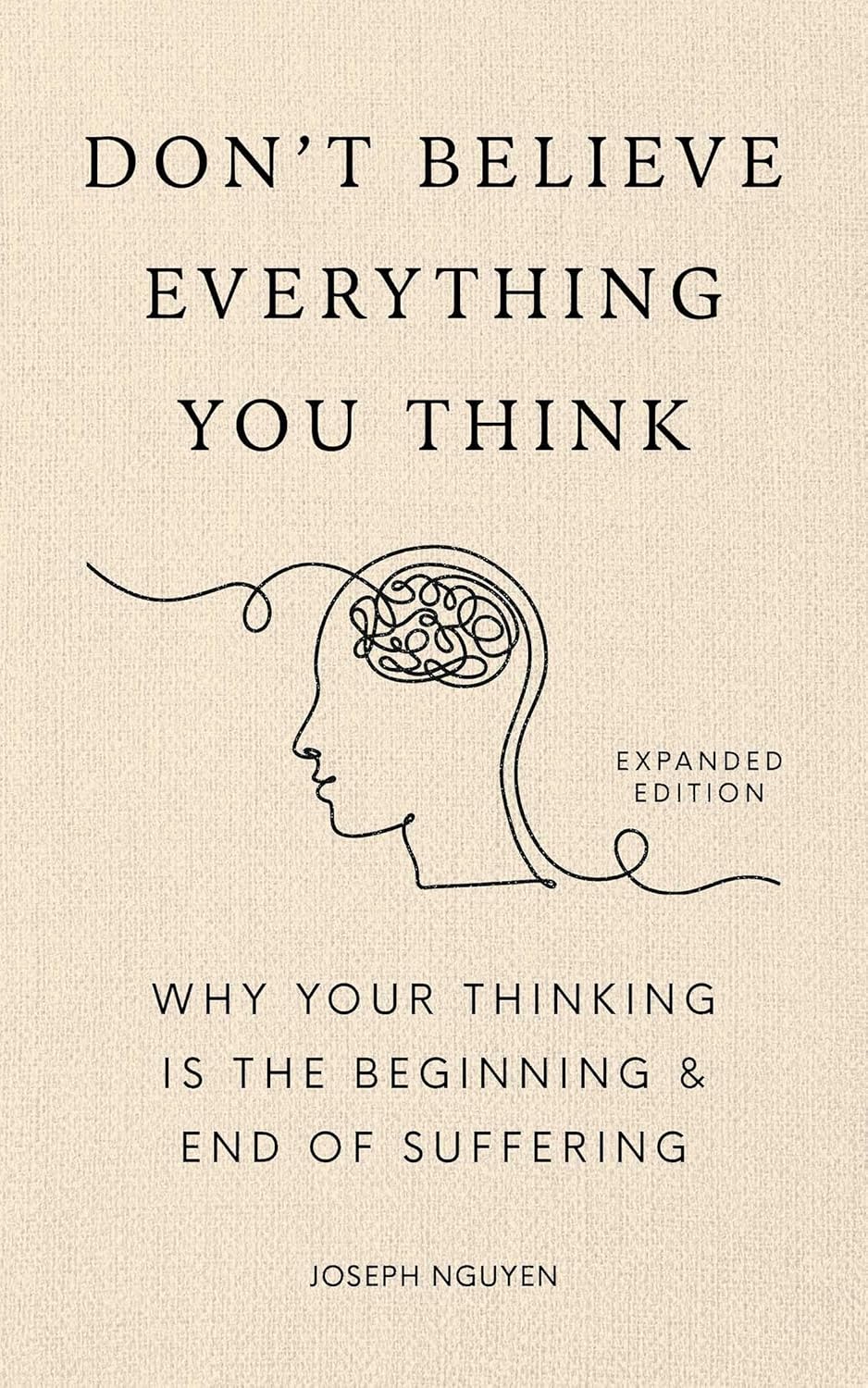
Modern life has trapped you in endless mental loops that create unnecessary suffering. Joseph Nguyen’s revolutionary book “Don’t Believe Everything You Think” offers a refreshing escape from the tyranny of overthinking through a completely different understanding of consciousness itself.
Is "Don't Believe Everything You Think" worth reading for mental peace and clarity? Absolutely. This transformative guide reveals how your thinking process—not your thoughts themselves—creates psychological suffering, while providing practical pathways to inner peace without relying on willpower or motivation. The book fundamentally shifts how you relate to your mental experience.
The Overthinking Epidemic
America faces an unprecedented mental health crisis rooted in excessive thinking. Recent statistics show that 42.5 million Americans suffer from anxiety disorders, making anxiety the most common mental health condition nationwide. Additionally, 19.1% of U.S. adults experienced anxiety disorders in the past year, with rates particularly high among women at 23.4%.
The constant stream of worrying thoughts, what-if scenarios, and mental rumination has become our default mode of existence. We’ve normalized psychological suffering as simply “part of life” without questioning whether this internal chaos is truly necessary. Nguyen argues that this epidemic isn’t caused by external circumstances but by our relationship with thinking itself.
Furthermore, the digital age has amplified our tendency to overthink. Social media, news cycles, and information overload feed directly into our mental processing systems, creating more material for anxious thoughts. The result is a society trapped in perpetual mental analysis that generates stress rather than solutions.
The moment we stop thinking is when our happiness begins. Joseph Nguyen
The Thinking-Thoughts Distinction
One of Nguyen’s most profound insights involves distinguishing between thoughts and thinking. Thoughts are the natural mental energy that forms the foundation of human experience—they’re spontaneous, automatic, and neutral. Thinking, however, is the conscious process of engaging with and elaborating on those thoughts.
This distinction revolutionizes how we understand psychological suffering. You can’t control which thoughts arise, but you absolutely control whether you engage with them through thinking. When you grab onto a worried thought and start analyzing it, creating stories around it, or trying to solve it, you activate the thinking process that generates emotional distress.
The book explains how thoughts themselves are harmless mental events, similar to clouds passing through the sky. They only gain power when we attach meaning and engage with them through deliberate thinking. This perspective aligns with scientific research on mindfulness, which shows that meditation changes our brain and biology in positive ways by altering our relationship with mental phenomena.
Nguyen provides practical examples of this distinction. When you notice the thought “I might fail at this presentation,” you have two options: engage with it through thinking (analyzing all the ways you might fail, creating backup plans, rehearsing worst-case scenarios) or simply acknowledge it as a passing mental event without elaboration.
The Root of Suffering
The book’s central thesis argues that thinking—not external circumstances—creates all psychological and emotional suffering. This perspective draws from ancient wisdom traditions while presenting the concept in modern, accessible language. Nguyen explains that pain is inevitable as part of human existence, but suffering is optional and self-created through our thinking processes.
This insight has profound implications for how we approach life challenges. Instead of trying to control external situations or outcomes, we can focus on managing our internal response through non-thinking states. The author provides compelling evidence that most of our worries never materialize, yet we suffer as if they’re already happening.
The book explores how thinking creates false narratives about reality. We construct elaborate stories about what events mean, what others think of us, and what the future holds. These mental constructions feel real and urgent, but they’re ultimately fictional creations of our thinking mind.
Thought is not reality; yet it is through thought that our realities are created. Joseph Nguyen
The Science Behind Non-Thinking
Recent neuroscience research supports Nguyen’s core premise about the benefits of quieting mental chatter. A 2025 study published in Science Daily found that meditation leads to changes in activity in the amygdala and hippocampus, key brain regions involved in emotional regulation and memory.
The research demonstrates that practices reducing mental activity create measurable changes in brain structure and function. Mount Sinai researchers discovered that meditation induces changes in deep brain areas associated with memory and emotional regulation, providing scientific validation for Nguyen’s approach.
These findings align with the book’s assertion that accessing non-thinking states isn’t mystical or unscientific—it’s a natural human capacity that can be developed and strengthened. The brain’s neuroplasticity allows us to rewire our default patterns of mental engagement, moving from reactive thinking to responsive awareness.
Additionally, studies on mindfulness meditation show that practitioners develop enhanced emotional regulation, improved attention, and reduced stress responses. These benefits occur not through thinking about problems differently, but through changing the fundamental relationship with mental activity itself.
Score: 8/10
This book earns a strong rating for its transformative potential and unique perspective on mental suffering. Nguyen successfully challenges conventional approaches to anxiety and overthinking while providing practical guidance for implementation. The book’s strength lies in its simplicity and accessibility, making profound concepts understandable for general readers.
The main limitation is occasional repetitiveness, as Nguyen sometimes reiterates key points rather than developing them further. Some readers might also find the spiritual undertones challenging if they prefer purely scientific approaches. However, these minor issues don’t detract from the book’s overall impact and utility.

What Will You Learn
After reading “Don’t Believe Everything You Think,” you’ll understand:
- The crucial difference between thoughts and thinking processes
- How to recognize when you’re caught in unnecessary mental loops
- Practical techniques for accessing non-thinking states of awareness
- Why willpower and motivation aren’t required for lasting change
- How to develop unconditional love and acceptance for yourself
- The role of intuition in decision-making beyond rational analysis
- Methods for creating from states of flow rather than forced effort
- How to handle uncertainty without anxiety or stress
- The connection between thinking patterns and emotional suffering
- Strategies for breaking free from self-sabotaging behaviors
Reader Testimonials
This book completely changed how I approach my anxiety. Instead of trying to think my way out of worry, I learned to step back from the thinking process entirely. The relief was immediate and lasting. – Sarah M., verified reader
I was skeptical about the ‘don’t think’ approach, but Nguyen explains it so clearly that it actually makes perfect sense. My stress levels dropped dramatically after implementing these concepts. – Michael R., Amazon customer
As someone who’s read every self-help book on anxiety, this one is different. It doesn’t give you more things to think about—it shows you how to think less. Revolutionary. – Jennifer L., Goodreads reviewer
Practical Applications
The book provides several actionable strategies for implementation:
The PAUSE Method:
- Pause when you notice anxious or repetitive thinking
- Acknowledge the thought without judgment
- Understand it’s just mental activity, not reality
- Step back from engagement with the thought
- Experience the peace that remains
Daily Practice Suggestions:
- Morning awareness sessions to start the day without mental clutter
- Regular check-ins to notice when thinking has become excessive
- Evening reflection to release accumulated mental tension
- Mindful activities that naturally quiet the thinking mind
- Journaling exercises to distinguish between thoughts and thinking
The Neuroscience Connection
Modern research increasingly supports Nguyen’s central premise. Studies from 2025 show that experienced meditators display distinct patterns in their brain’s spontaneous activity, even when not actively meditating. This research provides compelling evidence that long-term mindfulness practice creates lasting changes in how our brains function at rest.
The implications are profound: by learning to disengage from thinking processes, we can literally rewire our brains for greater peace and emotional stability. This isn’t about suppressing thoughts or forcing positivity—it’s about developing a healthier relationship with mental activity itself.
Furthermore, research on metacognitive awareness shows that understanding how our minds work enhances our ability to regulate emotions and attention. Nguyen’s book provides exactly this kind of metacognitive training, helping readers develop awareness of their thinking processes.
Pros and Cons
Pros:
- Offers a completely fresh perspective on anxiety and overthinking
- Provides practical tools that don’t require willpower or motivation
- Accessible writing style makes complex concepts understandable
- Supported by growing neuroscience research on meditation and mindfulness
- Short, focused format respects readers’ time and attention
Cons:
- Some readers may find the spiritual elements challenging
- Occasional repetition of key concepts throughout chapters
- Limited discussion of severe mental health conditions requiring professional treatment
The Universal Mind Concept
Nguyen introduces the concept of Universal Mind as the source of spontaneous thoughts and creative insights. This perspective suggests that our individual minds are connected to a larger intelligence that provides guidance and wisdom when we’re not actively thinking our way through problems.
This concept aligns with historical accounts of breakthrough discoveries and creative insights that seemed to come from beyond individual thinking. Scientists, artists, and inventors throughout history have reported that their greatest insights arrived during moments of mental quiet rather than intense analytical thought.
The book presents this not as mystical belief but as practical reality—when we stop trying to force solutions through thinking, we create space for natural intelligence to emerge. This approach can transform how you approach challenges, decisions, and creative projects.
Breaking Free from Mental Loops
One of the book’s most valuable contributions is its explanation of how to escape repetitive thought patterns. Nguyen describes how certain thoughts become “sticky” because we keep returning to them, creating mental grooves that become increasingly difficult to escape.
The solution isn’t to fight these thoughts or try to think differently—it’s to recognize the futility of mental loops and simply step out of them. This requires developing what the author calls “non-thinking awareness,” a state of alert presence that doesn’t engage with mental content.
The book provides specific techniques for recognizing when you’re caught in mental loops and practical methods for disengaging. These tools prove especially valuable for people who struggle with anxiety, depression, or obsessive thinking patterns.
Verdict
“Don’t Believe Everything You Think” stands as an essential guide for anyone seeking genuine mental peace in our overthinking culture. Nguyen’s approach offers hope for those who’ve tried conventional methods without lasting success, providing a radically different path to psychological well-being.
The book succeeds in making profound spiritual and psychological insights accessible to modern readers. Whether you’re struggling with anxiety, seeking greater creativity, or simply wanting more peace in daily life, this book provides practical tools for transformation.
Most importantly, Nguyen’s work offers permission to stop the exhausting effort of trying to think your way to happiness. By recognizing that peace is our natural state when thinking subsides, readers can access immediate relief from mental suffering.
The book’s impact extends beyond individual healing to offer a new paradigm for human consciousness. In a world increasingly dominated by mental activity and information overload, “Don’t Believe Everything You Think” provides a timely reminder that our wellbeing doesn’t depend on thinking more—it depends on thinking less.
Video Credit: Productivity Game / YouTube
Frequently Asked Questions
Is this book suitable for people with diagnosed mental health conditions?
While the book offers valuable insights for anyone struggling with overthinking, it’s important to note that it’s not a substitute for professional mental health treatment. People with diagnosed conditions like clinical depression, anxiety disorders, or PTSD should continue working with qualified healthcare providers while using this book as a complementary resource.
The concepts presented can be particularly helpful for understanding the role of thinking in mental suffering, but severe mental health conditions often require comprehensive treatment approaches including therapy, medication, and other interventions that go beyond the scope of any single book.
How quickly can someone expect to see results from applying these concepts?
Many readers report experiencing some relief within the first few days of implementing the book’s principles, particularly when they begin recognizing the difference between thoughts and thinking. However, developing consistent non-thinking awareness typically takes several weeks of practice.
The book emphasizes that results don’t depend on effort or willpower, which can actually accelerate the process for some people. Those who approach the concepts with openness and curiosity rather than forced effort often experience faster shifts in their mental experience.
Does the book provide enough practical guidance for implementation?
While the book contains practical exercises and examples, some readers might desire more detailed step-by-step instructions. The author’s approach is intentionally simple, focusing on understanding rather than complex techniques. This simplicity is both a strength and potential limitation depending on your learning style.
The book works best when combined with personal experimentation and possibly additional resources like meditation apps, mindfulness courses, or working with teachers who understand these concepts. The foundational understanding provided creates a strong basis for further exploration.
Can this approach work for people who need to think analytically for work?
The book doesn’t advocate for eliminating all thinking but rather for developing awareness of when thinking is helpful versus when it becomes compulsive and suffering-inducing. Professional tasks requiring analysis, problem-solving, and strategic thinking can coexist with the principles presented.
The key distinction is between purposeful thinking directed toward specific outcomes and involuntary mental chatter that creates emotional distress. Learning to access non-thinking states actually enhances creativity and problem-solving abilities when analytical thinking is genuinely needed.
Is there scientific support for the book’s main concepts?
Yes, growing neuroscience research supports many of the book’s central claims. Studies on meditation and mindfulness consistently show that practices reducing mental activity create positive changes in brain structure and function, particularly in areas related to emotional regulation and stress response.
Research on metacognitive awareness, the ability to observe your own thinking processes, demonstrates that this capacity enhances emotional regulation and reduces anxiety. While the book presents these concepts in accessible language rather than scientific terminology, the underlying principles align with current research on consciousness and mental well-being.
Purchase: Get Don’t Believe Everything You Think on Amazon
Sources:
- LAOP Center – Anxiety Statistics in the United States
- NIMH – Any Anxiety Disorder Statistics
- APA – Mindfulness Meditation Benefits
- Science Daily – Meditation Brain Changes
- Mount Sinai – Meditation Research
Read More: