

Your ability to understand what others truly think and feel determines how successfully you navigate every relationship, negotiation, and interaction in your life.
Is "Read People Like a Book" worth reading for improving social skills and understanding human behavior? Absolutely. Patrick King's practical guide transforms complex psychological concepts into actionable strategies for reading nonverbal cues, detecting lies, and understanding human motivations while building stronger relationships through enhanced empathy and social awareness.
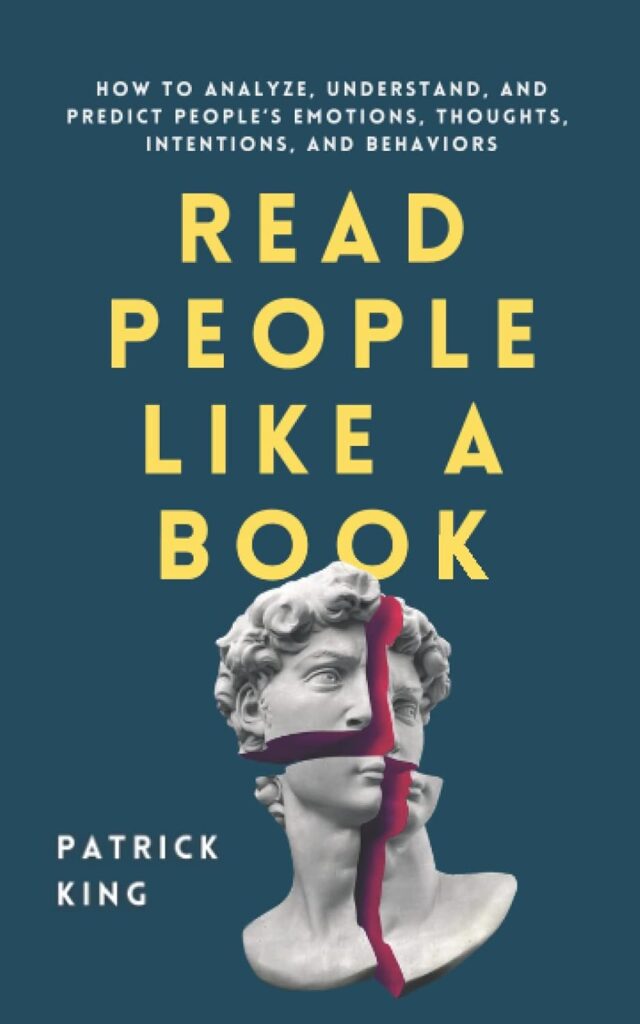
The Hidden Language
Every day, you encounter countless people whose true thoughts remain concealed behind polite conversation and social masks. Nevertheless, Patrick King argues that human behavior follows predictable patterns that anyone can learn to recognize and interpret. His approach moves beyond superficial body language tips to explore the psychological foundations driving human actions.
Moreover, King emphasizes that reading people isn’t about gaining manipulative advantage—it’s about developing deeper empathy and more authentic connections. When you understand what motivates others, you can communicate more effectively, resolve conflicts constructively, and build relationships based on genuine understanding rather than assumptions.
The author’s background as a social interaction specialist brings credibility to his methods. Rather than presenting abstract theories, King provides concrete techniques tested through real-world application in dating, business negotiations, and everyday social interactions.
The meeting of two personalities is like the contact of two chemical substances: if there is any reaction, both are transformed. Carl Jung
Psychological Foundations
Understanding human behavior requires recognizing the fundamental drives that motivate all actions. King breaks these down into several key categories, starting with subconscious urges that stem from what psychologist Carl Jung termed the “shadow”—the repressed aspects of personality that people try to hide from others and sometimes themselves.
Furthermore, King explores how the pleasure principle governs much human behavior. People instinctively seek pleasure while avoiding pain, but this drive operates more complexly than simple hedonism. The author explains how emotional responses often override logical thinking, leading to seemingly irrational decisions that make perfect sense when viewed through this psychological lens.
The book also examines Maslow’s Hierarchy of Needs as a framework for understanding motivation. Research from Harvard Business School confirms that recognizing which level of needs someone is addressing—from basic survival to self-actualization—dramatically improves your ability to communicate with and influence them effectively.
Additionally, King addresses ego protection as a powerful motivator. People will go to extraordinary lengths to maintain their self-image and avoid admitting mistakes or weaknesses. Understanding this drive helps explain many otherwise puzzling behaviors and reactions.
Nonverbal Communication
The most fascinating aspect of human interaction occurs without words. According to Albert Mehrabian’s research, communication breaks down as 55% body language, 38% vocal tone, and only 7% actual words. This means you’re missing the majority of any conversation if you focus solely on verbal content.
Subsequently, King teaches readers to recognize microexpressions—brief, involuntary facial expressions that reveal true emotions before conscious control kicks in. These fleeting signals, lasting mere fractions of seconds, provide windows into authentic feelings that contradict spoken words.
The author also explores how different body positions communicate various psychological states. Fight, flight, or freeze responses manifest through specific physical postures that evolved over millions of years and remain consistent across cultures. Someone leaning back might be experiencing psychological retreat, while forward positioning often indicates engagement or aggression.
King’s treatment of mirroring behaviors reveals how unconsciously people copy others they like or feel connected to. Conversely, a lack of mirroring often signals discomfort, disagreement, or social distance. This knowledge helps you gauge relationship dynamics and adjust your approach accordingly.
We have two ears and one mouth so that we can listen twice as much as we speak. Epictetus
Detecting Deception
One of the book’s most practical sections focuses on lie detection—a skill valuable in both personal and professional contexts. However, King warns against relying on popular misconceptions about deception cues. Many supposed “tells” like avoiding eye contact or fidgeting can indicate nervousness rather than dishonesty.
Instead, the author advocates for a holistic approach that considers multiple factors simultaneously. Effective lie detection requires establishing baseline behavior, looking for clusters of suspicious indicators, and paying attention to contextual factors that might explain unusual behavior.
King’s strategy involves engaging suspected liars in extended conversation to stress-test their stories. The cognitive load of maintaining false narratives increases over time, making inconsistencies more likely to emerge. By asking open-ended questions and gradually shifting to specific details, you can identify weak points in fabricated accounts.
The book also addresses emotional incongruence as a deception indicator. When someone’s emotional responses don’t match their claims—appearing overly casual about supposedly exciting news or getting angry when asked simple clarifying questions—they may be concealing the truth.
Personality Assessment
Understanding individual personality differences enables more effective communication and relationship building. King provides frameworks for quickly assessing personality types and adapting your approach accordingly. Rather than rigid categorization, he emphasizes recognizing behavioral patterns and response tendencies.
The author explores how different personality types handle conflict, make decisions, and process information. Some people prioritize logic and analysis, while others respond primarily to emotional appeals. Recognizing these differences prevents misunderstandings and enables more persuasive communication.
King also addresses how environmental factors influence personality expression. Someone might appear introverted in large groups but become animated in one-on-one conversations. Understanding these contextual variations prevents inaccurate personality assessments based on limited observations.
Contemporary psychology research supports King’s emphasis on adaptable communication styles. Leaders who adjust their approach based on individual personality differences achieve better outcomes than those using one-size-fits-all strategies.
When dealing with people, remember you are not dealing with creatures of logic, but with creatures bristling with prejudice and motivated by pride and vanity. Dale Carnegie
Cultural Considerations
While many nonverbal cues are universal, King acknowledges that cultural differences significantly impact interpretation. What constitutes appropriate eye contact, personal space, and gesture usage varies dramatically across cultures. The author provides guidance for navigating these differences without making offensive assumptions.
Similarly, King discusses how socioeconomic background influences communication patterns. Professional environments often require different behavioral interpretations than casual social settings. Understanding these contextual factors prevents misreading situations and people.
The book emphasizes developing cultural sensitivity alongside psychological insight. Effective people-reading requires balancing universal human nature with specific cultural and situational factors that shape individual behavior patterns.
Ethical Applications
King addresses the ethical implications of enhanced people-reading abilities throughout the book. He distinguishes between using these skills for mutual benefit versus manipulation or exploitation. The author advocates for applying psychological insights to improve relationships and communication rather than gaining unfair advantage over others.
The book provides guidelines for ethical application of influence techniques. King emphasizes creating win-win situations where understanding others’ motivations leads to outcomes beneficial for all parties involved. This approach builds long-term trust and relationship quality rather than short-term manipulation.
Furthermore, King discusses how enhanced empathy naturally develops alongside improved people-reading skills. As you better understand what drives others’ behavior, you become more compassionate toward their struggles and more skilled at providing genuine support.
The ability to observe without evaluating is the highest form of intelligence. Jiddu Krishnamurti
Practical Implementation
The book excels at providing concrete application strategies for various life situations. King offers specific techniques for job interviews, dating scenarios, business negotiations, and family relationships. Each context requires different approaches while utilizing the same underlying psychological principles.
Additionally, King provides exercises for developing observation skills and emotional intelligence. These practice activities help readers build competency gradually rather than expecting immediate mastery of complex psychological concepts.
The author emphasizes that people-reading abilities improve with conscious practice and attention. Like any skill, psychological insight develops through consistent application and refinement over time.
Score: 7/10
This book deserves solid marks for its practical approach to understanding human behavior. King successfully transforms complex psychological concepts into accessible strategies that readers can immediately apply. The emphasis on ethical application and relationship building distinguishes it from purely manipulative approaches.
However, the book occasionally oversimplifies complex psychological phenomena and may give readers overconfidence in their interpretive abilities. Some claims lack rigorous scientific backing, relying more on anecdotal evidence than peer-reviewed research.

What Will You Learn
After reading “Read People Like a Book,” you’ll master:
- Strategies for detecting deception through conversation techniques and behavioral analysis
- Methods for quickly assessing personality types and adapting your communication accordingly
- Techniques for building rapport and trust through enhanced understanding of others’ needs
- The psychological foundations underlying human motivation and decision-making processes
- How to recognize and interpret microexpressions and nonverbal cues across different contexts
- Ways to apply people-reading skills ethically in professional and personal relationships
- Cultural considerations that affect nonverbal communication interpretation
- Practical exercises for developing emotional intelligence and observational skills
Reader Testimonials
This book opened my eyes to so much nonverbal communication I was missing. The techniques for reading body language have genuinely improved my relationships and helped me navigate workplace dynamics more effectively. Jennifer M., verified purchaser
King provides practical strategies that actually work in real situations. I’ve become much better at understanding what people really think and feel, which has made me a more effective leader and communicator. David R., verified purchaser
The section on detecting lies was particularly valuable for my work in sales. I can now better understand customer concerns and objections, which has significantly improved my closing rates. Sarah L., verified purchaser
Pros and Cons
Pros:
- Practical techniques that can be immediately applied in various life situations
- Comprehensive coverage of psychological principles underlying human behavior
- Ethical approach emphasizing mutual benefit rather than manipulation
- Clear writing style that makes complex concepts accessible to general readers
- Specific examples and case studies that illustrate abstract principles
Cons:
- Some claims lack rigorous scientific evidence and rely heavily on anecdotal support
- May oversimplify complex psychological phenomena leading to overconfident interpretations
People-Reading Strategies
King outlines a systematic approach to analyzing human behavior:
Observation Phase
- Establish baseline behavior – Notice how someone normally acts before looking for deviations
- Consider contextual factors – Account for environmental and situational influences
- Look for clusters – Avoid drawing conclusions from single behavioral indicators
Analysis Phase
- Identify motivation level – Determine which needs hierarchy level someone is addressing
- Assess emotional state – Read microexpressions and energy levels accurately
- Evaluate consistency – Compare verbal claims with nonverbal signals
Application Phase
- Adapt communication style – Match your approach to their personality type
- Build rapport strategically – Use mirroring and empathy to create connection
- Verify interpretations – Test your assessments through follow-up interaction
Research Validation
Modern neuroscience increasingly supports many of King’s core principles about nonverbal communication and behavioral analysis. Studies show that 55% of communication is nonverbal, validating the book’s emphasis on body language interpretation over verbal content analysis.
Recent research from Verywell Mind confirms that facial expressions, eye contact patterns, and physical positioning provide reliable insights into emotional states and intentions. These findings support King’s systematic approach to behavioral observation.
Additionally, psychological studies validate the importance of understanding individual differences in communication styles. Leaders who adapt their approach based on personality assessments achieve significantly better outcomes than those using standardized methods.
Modern Applications
The book’s principles prove increasingly relevant in digital-age interactions. Video calls, social media behavior, and online communication patterns provide new venues for applying people-reading skills. King’s foundational concepts translate effectively to virtual environments with appropriate adaptation.
Social media profiles, communication timing, and digital interaction patterns offer windows into personality and motivational factors. Understanding these modern behavioral expressions extends the book’s traditional face-to-face focus into contemporary relationship contexts.
Professional applications continue expanding as remote work and virtual collaboration become standard. The ability to read people through limited digital channels becomes increasingly valuable for leadership, sales, and relationship management.
Verdict
“Read People Like a Book” succeeds as an accessible introduction to applied psychology and behavioral analysis. King’s practical approach makes complex concepts immediately usable while maintaining focus on ethical application and relationship enhancement.
The book’s greatest strength lies in transforming abstract psychological principles into concrete strategies for everyday situations. Whether you’re navigating workplace politics, building personal relationships, or improving communication skills, King provides actionable techniques that produce measurable results.
Most importantly, the author emphasizes using enhanced understanding to create better relationships rather than gaining manipulative advantage. This ethical foundation makes the book valuable for long-term personal development rather than short-term tactical gains.
While some claims lack rigorous scientific support, the core principles align with established psychological research. The practical exercises and real-world applications provide immediate value for readers committed to developing their emotional intelligence and social awareness.
For anyone seeking to improve their ability to understand and connect with others, “Read People Like a Book” offers a solid foundation. The combination of psychological insight, practical techniques, and ethical guidance creates a resource that enhances both personal effectiveness and relationship quality.
The book works best for readers who approach it as a starting point for developing enhanced social awareness rather than expecting immediate mastery of complex psychological assessment. With consistent practice and continued learning, King’s strategies can significantly improve your ability to navigate human relationships with greater insight and empathy.
Video Credit: Let’s Talk Psychology Podcast / YouTube
Frequently Asked Questions
Is this book suitable for people without psychology background?
Absolutely. King writes specifically for general audiences and avoids technical jargon that might confuse readers without formal psychology training. The author uses everyday examples and clear explanations that make complex behavioral concepts immediately understandable and applicable.
The book serves as an excellent introduction to applied psychology, providing foundational knowledge without overwhelming readers with academic theory. King focuses on practical skills rather than theoretical frameworks, making the content accessible to anyone interested in improving their social awareness.
How quickly can you see results from applying these techniques?
Many readers report noticing improved social interactions within weeks of implementing King’s strategies. However, developing sophisticated people-reading abilities requires ongoing practice and refinement over months and years rather than immediate mastery.
The book provides both quick-win techniques for immediate application and longer-term skill development strategies. Simple awareness improvements often yield immediate benefits, while more nuanced behavioral analysis skills develop gradually through consistent practice and observation.
Does the book address online and digital communication?
While King focuses primarily on face-to-face interaction, many principles translate effectively to digital communication environments. Text patterns, response timing, emoji usage, and video call behavior all provide insights into personality and emotional states using similar analytical approaches.
The core psychological principles remain consistent across communication channels. Understanding motivation, personality differences, and emotional patterns applies whether you’re interpreting in-person behavior or digital interaction patterns.
Can these skills be used ethically in professional settings?
Yes, when applied appropriately. King emphasizes using people-reading skills to improve communication, build better relationships, and create mutually beneficial outcomes rather than manipulating or taking advantage of others. Professional applications focus on understanding colleague needs, customer preferences, and team dynamics.
The key is maintaining respect for others’ privacy and autonomy while using psychological insights to communicate more effectively. This approach enhances professional relationships and outcomes without crossing ethical boundaries or violating trust.
Are the techniques culturally universal or specific to Western contexts?
King acknowledges cultural variations while focusing primarily on universal human behaviors and psychological patterns. Many nonverbal cues vary significantly across cultures, requiring adaptation of interpretation techniques based on cultural context and individual background.
The book provides a foundation that readers should supplement with cultural-specific knowledge when interacting across different backgrounds. The psychological principles remain consistent, but their expression and interpretation require cultural sensitivity and awareness.
Purchase: Get Read People Like a Book on Amazon
Sources:
- Harvard Business School – Psychology and Leadership Research
- University of Texas – Nonverbal Communication Statistics
- American Psychological Association – Nonverbal Communication
- Passive Secrets – Body Language Statistics 2025
- Verywell Mind – Types of Nonverbal Communication
Read More: