

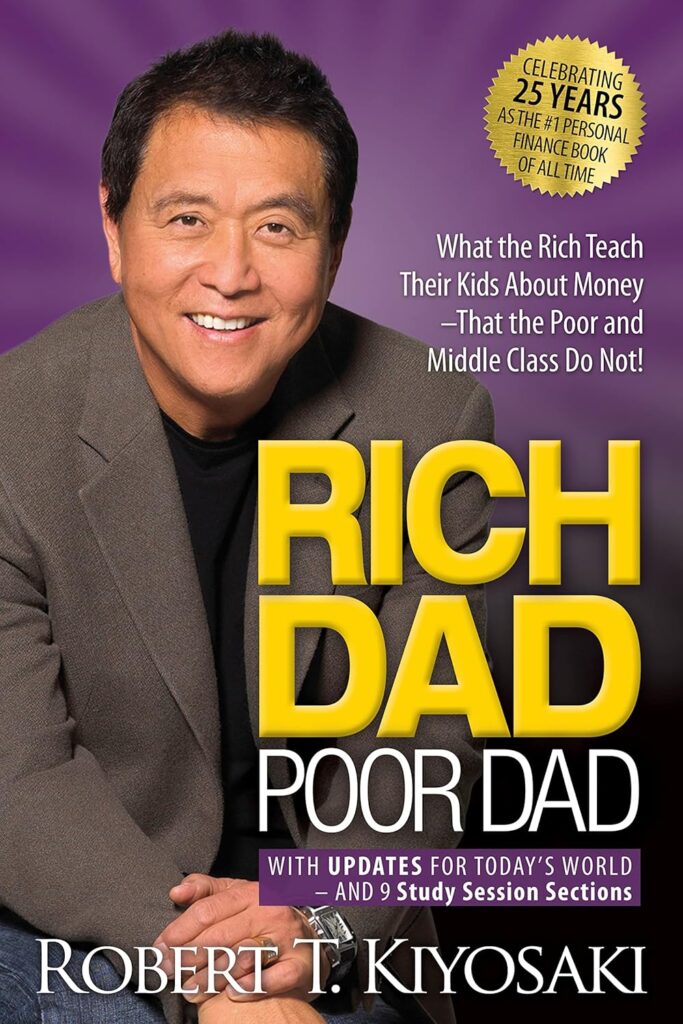
Your financial education might be costing you millions without you even realizing it. Robert Kiyosaki’s groundbreaking masterpiece “Rich Dad Poor Dad” exposes the dangerous money myths that keep ordinary people trapped in financial mediocrity while revealing the wealth-building secrets that separate the rich from everyone else.
Does "Rich Dad Poor Dad" actually work for building wealth? Absolutely. This revolutionary book transforms your entire relationship with money by teaching you to think like an investor rather than an employee. Kiyosaki's proven principles have helped millions escape the rat race and build lasting financial freedom through smart asset acquisition and cash flow management.
Money Education Crisis
The American financial education system has failed catastrophically. Meanwhile, financial literacy rates have plummeted to just 48% in 2024, leaving millions of adults financially vulnerable and unprepared for economic challenges. This educational gap costs the average American $1,015 annually in poor financial decisions.
Furthermore, traditional schooling teaches students to be employees, not entrepreneurs or investors. Schools emphasize job security over financial intelligence, creating generations of workers who trade time for money without building wealth. Kiyosaki’s book directly challenges this broken system by providing the financial education most people never received.
The consequences of financial illiteracy extend beyond individual struggles. According to recent research, most Americans cannot distinguish between assets and liabilities, the fundamental building blocks of wealth creation. This knowledge gap perpetuates cycles of financial dependence that span generations.
The poor and the middle class work for money. The rich have money work for them. Robert Kiyosaki
Financial Intelligence Framework
Kiyosaki introduces four pillars of financial intelligence that distinguish wealthy individuals from everyone else. The first pillar involves understanding cash flow patterns and recognizing how money moves through different financial vehicles. This knowledge enables you to identify opportunities that generate passive income rather than simply trading hours for dollars.
Additionally, the book emphasizes tax advantages available to business owners and investors that employees cannot access. Studies show that business owners benefit from numerous tax strategies unavailable to traditional employees, potentially saving thousands annually. This tax education alone justifies the book’s value for most readers.
The framework also addresses investment psychology and risk management. Kiyosaki explains how wealthy people evaluate opportunities differently than middle-class individuals, focusing on potential returns rather than job security. This mindset shift proves crucial for building long-term wealth.
The fourth pillar involves developing business systems that generate income without your direct involvement. This concept of scalable income sources forms the foundation of true financial freedom, allowing you to earn money while focusing on other pursuits or investments.
Asset vs Liability Revelation
Most people fundamentally misunderstand the difference between assets and liabilities, making financial decisions that actually reduce their wealth over time. Kiyosaki’s definitions revolutionize how you evaluate every purchase and investment opportunity throughout your life.
Traditional thinking considers your primary residence an asset, but Kiyosaki demonstrates how it actually functions as a liability by requiring monthly payments without generating income. This perspective shift helps readers prioritize cash-flowing investments over status symbols that drain their resources.
The book provides practical examples of true assets: rental properties, stocks that pay dividends, businesses that operate without your daily involvement, and intellectual property that generates royalties. These examples help readers identify similar opportunities in their own lives and communities.
It’s not how much money you make, but how much money you keep, how hard it works for you, and how many generations you keep it for. Robert Kiyosaki
Understanding this distinction changes your entire approach to major purchases. Instead of asking “Can I afford this?” you learn to ask “Will this make me money or cost me money over time?” This simple mental shift prevents countless wealth-destroying decisions throughout your lifetime.
Corporate Structure Advantages
The wealthy leverage corporate structures and legal entities to protect and grow their wealth in ways unavailable to individual taxpayers. Kiyosaki explains how business ownership provides tax advantages, liability protection, and investment opportunities that dramatically accelerate wealth accumulation.
Business owners can deduct legitimate business expenses before paying taxes, while employees pay taxes first and live on what remains. This fundamental difference in tax treatment can save wealthy individuals tens of thousands of dollars annually while providing additional benefits like business write-offs for vehicles, travel, and education.
The book also explores how corporations shield personal assets from business liabilities and legal challenges. This protection becomes increasingly important as your wealth grows and you become a more attractive target for frivolous lawsuits or business disputes.
Furthermore, corporate ownership enables access to sophisticated investment vehicles and business opportunities typically reserved for accredited investors. These exclusive opportunities often provide superior returns compared to traditional investments available to individual investors.
Work vs Investment Philosophy
Traditional employment exchanges your time for money in a linear relationship that limits your earning potential and requires constant effort to maintain income. Kiyosaki advocates transitioning from active income to passive income through strategic investments and business ownership.
The book explains how wealthy individuals focus on acquiring assets that generate cash flow while they sleep, travel, or pursue other interests. This approach creates true financial freedom by eliminating the direct relationship between your time and your income.
The single most powerful asset we all have is our mind. If it is trained well, it can create enormous wealth in what seems to be an instant. Robert Kiyosaki
Additionally, employment income faces significant limitations through salary caps and corporate hierarchies that control your advancement potential. Business ownership and investment income have no such restrictions, allowing unlimited growth potential based on your skills and decisions rather than corporate policies.
The philosophy extends beyond mere income generation to encompass personal development and skill acquisition. Entrepreneurs develop diverse capabilities while employees often specialize in narrow areas, creating different levels of adaptability and opportunity recognition over time.
Real Estate Investment Strategies
Property investment forms a cornerstone of wealth building throughout the book, with detailed explanations of how real estate generates both cash flow and appreciation over time. Kiyosaki demonstrates how leverage amplifies returns while providing tax advantages unavailable through other investment vehicles.
The book covers various real estate strategies including rental properties, commercial investments, and real estate investment trusts (REITs). Each approach offers different risk profiles and return potentials, allowing readers to choose strategies aligned with their capital and risk tolerance.
Leverage strategies receive particular attention, showing how borrowed money can accelerate wealth building when used wisely. Recent statistics indicate that most Americans avoid debt entirely, missing opportunities to use leverage for wealth creation while the wealthy routinely use borrowed money to acquire appreciating assets.
Property investment also provides inflation protection and tax benefits through depreciation deductions and capital gains treatment. These advantages make real estate particularly attractive during inflationary periods when traditional savings accounts lose purchasing power.
Score: 8/10
Rich Dad Poor Dad earns high marks for fundamentally changing how readers think about money, work, and wealth building. The book successfully challenges conventional financial wisdom while providing actionable strategies that millions have used to improve their financial situations.
However, the book lacks specific implementation details and sometimes presents overly simplified scenarios that may not reflect real-world complexities. Additionally, some critics question certain anecdotes and specific claims made throughout the narrative.
Despite these limitations, the core concepts remain sound and applicable across different economic conditions and personal situations. The mindset shifts alone justify the investment for most readers seeking financial improvement.

What Will You Learn
After reading Rich Dad Poor Dad, you’ll master:
- The fundamental difference between assets and liabilities and how to apply this knowledge to every financial decision
- Why traditional employment limits wealth building and how to transition toward passive income generation
- Tax advantages available to business owners and investors that employees cannot access
- Real estate investment strategies that generate cash flow and long-term appreciation
- How to evaluate investment opportunities using cash flow analysis rather than conventional metrics
- The importance of financial education and continuous learning for wealth building
- Why your primary residence may be hindering rather than helping your financial progress
- How to use debt strategically to accelerate wealth accumulation rather than avoiding all borrowing
Reader Testimonials
“This book completely changed my perspective on money and investing. I’ve started my own business and bought my first rental property since reading it. The mindset shift has been incredible and I wish I’d read it years earlier.” – Sarah M., verified Amazon reviewer
“Rich Dad Poor Dad opened my eyes to possibilities I never considered. I realized my corporate job was actually limiting my potential. Now I’m building multiple income streams and my financial future looks completely different.” – Michael Rodriguez, Goodreads review
“I was skeptical at first, but the concepts really work. Started applying the asset vs liability principle and my cash flow improved dramatically within six months. This book should be required reading in high school.” – Jennifer K., verified purchaser
Pros and Cons
Pros:
- Fundamentally changes your relationship with money and wealth building
- Challenges conventional financial wisdom that keeps people financially limited
- Provides clear distinction between assets and liabilities that guides all future decisions
- Explains tax advantages and business structures that accelerate wealth accumulation
- Motivates readers to pursue financial education and take control of their economic future
- Easy-to-understand concepts presented through relatable storytelling
- Demonstrates how passive income creates true financial freedom
Cons:
- Lacks specific step-by-step implementation guidance for beginners
- Some anecdotes and scenarios may be oversimplified or questionable
- Focuses primarily on real estate and business ownership, potentially overlooking other wealth-building strategies
Wealth Building Action Plan
The book provides a framework for transitioning from employee mindset to investor thinking:
- Assess Your Current Financial Position – Calculate your assets, liabilities, and monthly cash flow
- Invest in Your Financial Education – Read books, attend seminars, and learn from successful investors
- Start Small with Cash-Flowing Assets – Begin with affordable investments that generate monthly income
- Establish Business Entity – Create legal structure for tax advantages and liability protection
- Reinvest Profits Strategically – Use income from assets to acquire additional income-producing investments
- Build Your Asset Portfolio – Diversify across real estate, businesses, and other cash-flowing investments
- Reduce Liabilities Systematically – Eliminate debt on items that don’t generate income
- Network with Like-Minded Investors – Surround yourself with people who share wealth-building goals
- Track and Optimize Performance – Monitor your investments and adjust strategies based on results
- Scale Your Success – Use proven strategies to acquire larger and more profitable assets
| Strategy Category | Risk Level | Potential Return | Time Commitment |
|---|---|---|---|
| Rental Real Estate | Medium | 8-15% annually | Medium |
| Business Ownership | High | 15-30%+ annually | High |
| Dividend Stocks | Low-Medium | 4-8% annually | Low |
| REITs | Medium | 6-12% annually | Low |
Financial Education Revolution
The book advocates for self-directed financial education rather than relying on traditional institutions that may not have your best interests in mind. This approach requires taking personal responsibility for your financial knowledge and continuously learning about money, investing, and business.
Recent data shows that 75% of American teens lack confidence in personal finance knowledge, highlighting the urgent need for improved financial education. Kiyosaki’s book fills this gap by providing practical insights often missing from formal education.
The emphasis on continuous learning extends beyond initial education to include staying current with economic trends, investment opportunities, and tax law changes. This ongoing commitment to financial education becomes increasingly valuable as your wealth and complexity of your investments grow.
Self-education also enables you to evaluate financial advice critically rather than blindly following recommendations from professionals who may have different incentives than your personal wealth building goals.
Market Timing and Opportunity
While specific investment recommendations may become outdated, the principles for identifying and evaluating opportunities remain timeless. Kiyosaki emphasizes developing skills to recognize valuable investments regardless of market conditions or economic cycles.
The book teaches readers to view market downturns as buying opportunities rather than reasons to panic or avoid investing entirely. This contrarian approach has proven successful for many wealthy investors who accumulate assets when prices are depressed.
In the real world, the smartest people are people who make mistakes and learn. In school, the smartest people don’t make mistakes. Robert Kiyosaki
Economic uncertainty and market volatility create the best opportunities for informed investors who understand how to evaluate assets based on fundamentals rather than market sentiment. These skills become increasingly valuable during challenging economic periods when most people retreat from investment activities.
The ability to act decisively during uncertain times separates successful investors from those who remain on the sidelines waiting for “perfect” conditions that rarely materialize in real markets.
Verdict
Rich Dad Poor Dad succeeds as a transformative introduction to wealth-building principles that challenge conventional financial wisdom. The book’s greatest strength lies in its ability to fundamentally change how readers think about money, work, and financial security.
While it may lack detailed implementation strategies, the mindset shifts and core concepts provide a solid foundation for further financial education and practical application. Most readers will benefit significantly from understanding the asset vs liability distinction alone.
The book works best as a starting point for financial education rather than a comprehensive guide. Readers should supplement its concepts with additional resources focused on specific investment strategies and implementation tactics.
For anyone stuck in the traditional employment model or struggling with financial limitations, this book offers a compelling alternative path toward financial independence. The investment in reading time and applying these concepts can literally pay dividends for decades.
Despite some criticisms regarding specific claims or oversimplified scenarios, the core message remains powerful and relevant. The book continues influencing millions of readers worldwide, creating countless success stories of financial transformation and wealth building.
Video Credit: Escaping Ordinary (B.C Marx) / YouTube
Frequently Asked Questions
Is Rich Dad Poor Dad suitable for complete beginners to personal finance?
Absolutely, and this is where the book truly shines. Kiyosaki deliberately wrote for people with no prior financial education, using simple language and relatable stories to explain complex concepts. The book assumes no background knowledge and builds understanding gradually through practical examples.
Many readers report that this was their first exposure to concepts like cash flow, assets versus liabilities, and passive income. The storytelling approach makes these ideas accessible even to people who typically avoid financial topics. However, beginners should view this as a starting point rather than a complete education, supplementing it with more detailed resources about specific investment strategies.
Do the principles still work in today’s economy and housing market?
The core principles remain highly relevant, though specific tactics may need adjustment for current market conditions. The fundamental concepts of acquiring cash-flowing assets, understanding tax advantages, and building passive income streams work regardless of economic cycles or market conditions.
Current real estate prices and interest rates require different strategies than those available when the book was written, but the underlying approach of evaluating investments based on cash flow rather than speculation remains sound. Recent statistics show that Americans continue struggling with basic financial concepts, making the book’s educational value more important than ever. Successful readers adapt the principles to current opportunities rather than expecting identical implementation.
How long does it typically take to see results from applying these concepts?
Results vary significantly based on individual circumstances, starting capital, and implementation consistency. Some readers report mindset changes and improved financial decision-making immediately after reading, while building substantial passive income typically takes several years of consistent effort.
Most success stories involve starting small with affordable cash-flowing investments and gradually scaling up through reinvestment and additional education. Early results often come from improved budgeting and debt reduction, followed by initial investment income within 6-12 months. Building significant wealth usually requires 5-10 years of consistent application, though some readers achieve faster results through business ownership or aggressive real estate strategies.
What’s the biggest misconception people have about this book?
Many people expect the book to provide specific, step-by-step investment instructions, but it’s primarily focused on changing your financial mindset and approach to money. The book teaches you how to think about wealth building rather than providing detailed implementation guides for specific investments.
Another common misconception involves viewing it as a “get rich quick” scheme. Kiyosaki emphasizes education, patience, and gradual wealth building through smart investment choices. The book advocates for long-term thinking and continuous learning rather than gambling or speculative investing. Readers who approach it as foundational education rather than a detailed action plan typically find much more value and success with implementation.
Should I start with real estate investing as the book suggests?
Real estate receives significant attention in the book because of its tax advantages, leverage opportunities, and cash flow potential. However, starting with real estate isn’t mandatory or appropriate for everyone’s situation and capital levels.
The principles apply to various asset classes including stocks, businesses, and alternative investments. Some readers begin with dividend-paying stocks or REITs to learn cash flow analysis before moving to direct real estate ownership. Others start small businesses or invest in their education first. The key is beginning with assets that generate income rather than focusing on any specific investment type. Choose starting points that match your capital, risk tolerance, and learning preferences while maintaining focus on cash flow and tax efficiency.
Purchase: Get Rich Dad Poor Dad on Amazon
Sources:
- TIAA Institute Financial Literacy Report 2024
- WalletHub Financial Literacy Statistics 2025
- World Economic Forum Financial Literacy Analysis
- MarketWatch Financial Illiteracy Impact Study
- MoneyZine Personal Finance Education Research
Read More: