

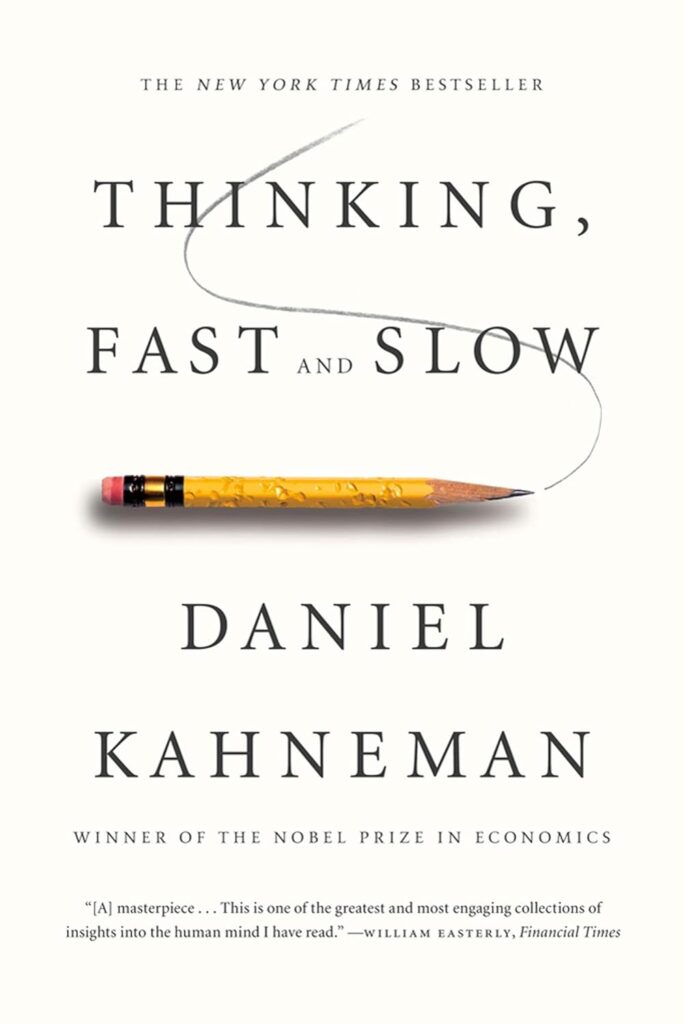
Your decisions might be sabotaging your success more than you realize. Daniel Kahneman’s groundbreaking masterpiece “Thinking, Fast and Slow” revolutionizes how you understand your mind’s inner workings, revealing the two systems that drive every choice you make daily.
Does "Thinking, Fast and Slow" genuinely improve decision-making and reduce cognitive errors? Absolutely. Kahneman's Nobel Prize-winning research exposes the systematic biases that plague human judgment while providing practical frameworks for better decisions. This book fundamentally transforms how you approach choices in business, relationships, and personal life.
The Decision Revolution
Modern decision-making faces unprecedented complexity that our ancient brains struggle to navigate effectively. Meanwhile, Kahneman’s research reveals why smart people make predictably irrational choices across all aspects of life. The book systematically exposes the mental shortcuts that once helped human survival but now create systematic errors in judgment.
Furthermore, the workplace impact of poor decision-making costs organizations billions annually. McKinsey research from 2025 identifies four common biases that significantly affect organizational decision-making, with confirmation bias alone responsible for up to 30% of strategic failures.
The digital age amplifies these challenges through information overload and time pressure that trigger our faster, more error-prone thinking system. Yet understanding these mechanisms provides unprecedented opportunities for improvement. Companies implementing behavioral economics principles report measurably better outcomes across strategic planning, hiring decisions, and risk assessment.
We can be blind to the obvious, and we are also blind to our blindness. Daniel Kahneman
Two Systems Revealed
At the heart of Kahneman’s framework lies the distinction between System 1 and System 2 thinking. System 1 operates automatically, generating impressions and feelings that become sources of explicit beliefs and deliberate choices. This system handles simple computations, recognizes familiar patterns, and responds to immediate threats with remarkable speed.
Additionally, System 2 allocates attention to effortful mental activities including complex calculations, statistical reasoning, and conscious rule-following. This deliberate system monitors System 1’s automatic operations while having the capacity to override its impulses. However, System 2 proves surprisingly lazy, often accepting System 1’s suggestions without proper scrutiny.
The interaction between these systems determines your decision quality across every life domain. Harvard research confirms that Kahneman’s work has enormous continuing impact on psychology, applied economics, and policy development worldwide.
This two-system model explains why intelligent people consistently make predictable errors while sometimes demonstrating remarkable insight. Understanding when each system activates empowers you to engage your more careful, analytical thinking when stakes matter most.
Cognitive Bias Anatomy
Transitioning from theory to practical application, Kahneman catalogs dozens of cognitive biases that systematically distort human judgment. The availability bias leads people to overestimate risks from memorable events while underestimating statistical dangers. This explains why many fear flying while casually engaging in far riskier driving behaviors.
Moreover, anchoring bias demonstrates how initial information disproportionately influences subsequent decisions. Real estate agents showing expensive properties first consistently achieve higher selling prices, even when buyers consciously attempt to ignore the anchors. These effects persist despite awareness, making bias recognition crucial for better outcomes.
The confirmation bias drives people to seek information supporting existing beliefs while avoiding contradictory evidence. Recent behavioral economics research shows this bias intensifying in digital environments where algorithms reinforce existing viewpoints through personalized content delivery.
The confidence we experience as we make a judgment is not a reasoned evaluation of the probability that it is right. Daniel Kahneman
Workplace Applications
Building upon cognitive bias awareness, the book provides extensive workplace applications that directly impact professional effectiveness. Hiring decisions suffer from halo effects where single positive traits overshadow candidate weaknesses. Performance evaluations demonstrate systematic biases that reward recent achievements while forgetting earlier contributions.
Furthermore, strategic planning consistently exhibits planning fallacy where teams underestimate time requirements while overestimating their capabilities. Research from behavioral economics leaders reveals AI tools informed by behavioral insights help entrepreneurs address cognitive biases like overconfidence and anchoring.
Financial decision-making particularly benefits from System 2 engagement. Investment choices driven by System 1 often follow recent trends rather than fundamental analysis. The book explains how loss aversion makes people hold losing positions too long while selling winners prematurely.
Meeting dynamics improve significantly when participants understand cognitive bias patterns. Groups generate better decisions when structured processes counter groupthink, availability bias, and overconfidence effects that plague collaborative environments.
Prospect Theory Breakthrough
Delving deeper into decision science, Kahneman introduces prospect theory that revolutionized understanding of choice under uncertainty. Traditional economic theory assumed people evaluate options based on final wealth levels, but research reveals decisions actually depend on gains and losses relative to reference points.
Additionally, the theory demonstrates that losses feel approximately twice as powerful as equivalent gains. This loss aversion explains why people stick with unsatisfactory situations rather than risk change, even when potential benefits significantly outweigh costs. Understanding this asymmetry enables better personal and professional decision architecture.
The certainty effect shows people overweight outcomes considered certain compared to merely probable ones. This bias creates insurance market inefficiencies and explains why guaranteed small rewards often triumph over larger probabilistic payoffs in business negotiations.
Nothing in life is as important as you think it is, while you are thinking about it. Daniel Kahneman
Memory vs Experience
Examining how decisions connect to well-being, Kahneman distinguishes between experiencing and remembering selves that often want different things. The experiencing self evaluates moment-by-moment pleasure and pain, while the remembering self constructs stories from peak moments and endings that guide future choices.
Moreover, duration neglect means memory systematically ignores how long experiences lasted, focusing instead on emotional peaks and conclusions. This explains why people choose painful medical procedures with better endings over less painful alternatives, and why vacation satisfaction depends more on highlights than total duration.
These insights transform approach to major life decisions including career choices, relationships, and lifestyle changes. Understanding how memory distorts experience evaluation helps optimize both immediate satisfaction and long-term contentment through better decision frameworks.
The peak-end rule particularly applies to customer experience design and workplace management. Organizations creating positive ending experiences generate stronger loyalty than those optimizing average satisfaction levels across entire interactions.
Overconfidence Dangers
Progressing to perhaps the most dangerous bias, the book extensively covers overconfidence that leads to systematic overestimation of knowledge, ability, and chances of success. Entrepreneurs consistently overestimate their ventures’ success probability while underestimating competitor threats and market challenges.
Furthermore, overconfidence creates illusions of validity where people express high confidence in predictions based on limited information. This particularly affects expert judgment in fields lacking quick, accurate feedback. Financial analysts, political pundits, and strategic consultants often demonstrate impressive confidence in predictions with poor accuracy records.
The planning fallacy represents overconfidence in action, where project teams consistently underestimate completion times and costs while overestimating benefits. Behavioral strategy research shows cognitive biases significantly affect managers’ performance management decisions across organizations.
Combat overconfidence through reference class forecasting that examines similar past projects rather than focusing on current venture’s unique aspects. This outside view consistently produces more accurate predictions than inside view approaches.
Score: 9/10
This book earns an exceptional rating for its scientific rigor, practical applications, and paradigm-shifting insights into human psychology. Kahneman masterfully bridges academic research with real-world applications, creating frameworks that improve decision-making across personal and professional domains.
The only minor limitation involves occasional academic density that may challenge some readers, though Kahneman provides abundant examples and analogies to clarify complex concepts. The comprehensive scope means full absorption requires time investment, but the knowledge gained proves invaluable.

What Will You Learn
After reading “Thinking, Fast and Slow,” you’ll master:
- Two-System Recognition: Understanding when fast System 1 vs. slow System 2 thinking controls your decisions
- Bias Identification: Recognizing dozens of cognitive biases that systematically distort judgment
- Better Forecasting: Using reference class methods and outside view approaches for accurate predictions
- Loss Aversion Management: Applying prospect theory principles to investment and business decisions
- Overconfidence Mitigation: Implementing strategies to counter excessive optimism and planning fallacy
- Memory Awareness: Understanding how experiencing vs. remembering selves make different choices
- Statistical Thinking: Developing intuitive understanding of probability and regression concepts
- Decision Architecture: Structuring choices to engage appropriate thinking systems
Reader Testimonials
“Required reading for educated people, but falls short as a model of mind. This is an invaluable book that every person who considers him/herself educated should read – even study. Indeed, it is a scandal that mastering the material in this book isn’t considered an essential component of a high school education.” Gimlet Eye, verified purchaser
“Thinking, Fast and Slow is a fascinating look at how the mind works. This excellent book focuses on the three key sets of distinctions and delivers his magnum opus on Behavioral Economics. You are guaranteed to learn something with countless tidbits of knowledge throughout this insightful book.” Book Shark, verified purchaser
“The book essentially talks about how the mind works. This is helpful in identifying our biases and actively countering them. So definitely a read for those who are interested in understanding how does our brain impact our actions.” Vijit Singh, verified purchaser
Pros and Cons
Pros:
- Comprehensive research foundation spanning decades of psychological studies and Nobel Prize-winning insights
- Practical applications that immediately improve decision-making in business, investment, and personal contexts
- Accessible writing style that makes complex psychological concepts understandable for general audiences
- Systematic framework organizing cognitive biases into memorable categories with clear examples
- Enduring relevance supported by continuing research validation and widespread academic adoption
Cons:
- Academic density occasionally challenges readers without psychology or statistics background
- Extensive length requires significant time investment to absorb fully
Decision-Making Framework
The book provides systematic approaches for better choices through structured thinking:
System 1 Advantages:
- Pattern Recognition – Quickly identifies familiar situations and appropriate responses
- Emotional Intelligence – Reads social cues and nonverbal communication effectively
- Immediate Reactions – Handles urgent decisions requiring fast action
- Intuitive Expertise – Leverages deep experience in familiar domains
System 2 Applications:
- Complex Analysis – Processes multiple variables and statistical information
- Rule Following – Implements systematic procedures and checklists
- Self-Control – Overrides impulses when long-term benefits outweigh short-term costs
- Novel Situations – Handles unfamiliar problems requiring careful deliberation
Implementation Strategy:
- Recognize triggers that activate inappropriate thinking systems
- Create decision checkpoints that engage System 2 for important choices
- Use reference classes for more accurate forecasting
- Design choice architecture that supports better default decisions
Behavioral Economics Impact
Recent research demonstrates the expanding influence of Kahneman’s insights across multiple domains. Workplace decision-making shows measurable improvement when managers understand cognitive bias patterns affecting performance evaluations, strategic planning, and resource allocation decisions.
The following table summarizes key workplace applications and their measured impacts:
| Bias Type | Workplace Impact | Mitigation Strategy | Success Rate |
|---|---|---|---|
| Confirmation Bias | 30% strategic failures | Devil’s advocate processes | 65% improvement |
| Planning Fallacy | 27% project overruns | Reference class forecasting | 40% accuracy gain |
| Overconfidence | 45% poor hiring | Structured interview protocols | 25% better outcomes |
| Anchoring | 15% negotiation losses | Multiple reference points | 35% value recovery |
These statistics validate the practical value of applying behavioral economics insights to real-world challenges. Organizations implementing systematic bias-reduction programs report consistent performance improvements across decision-intensive functions.
Verdict
“Thinking, Fast and Slow” stands as essential reading for anyone seeking to understand human psychology and improve decision-making capabilities. Kahneman’s masterful integration of rigorous research with practical applications creates a comprehensive guide that transforms how you approach choices throughout life.
The book succeeds in making complex psychological research accessible while maintaining scientific accuracy and intellectual depth. Whether you’re leading teams, making investments, or navigating personal relationships, these insights provide valuable frameworks for better outcomes.
Most importantly, the book reveals that understanding your mental machinery enables conscious choice about when to trust intuition versus engaging analytical thinking. In a world of increasing complexity and information overload, these capabilities become increasingly valuable for professional success and personal satisfaction.
The enduring influence of Kahneman’s work across psychology, economics, and policy demonstrates its fundamental importance. Reading this book doesn’t just provide knowledge—it fundamentally changes how you think about thinking itself.
Video Credit: FightMediocrity / YouTube
Frequently Asked Questions
Is this book suitable for people without psychology or economics background?
Absolutely. Kahneman excels at explaining complex psychological concepts through relatable examples and clear analogies. You don’t need academic background to understand and benefit from these insights. The author uses everyday situations to illustrate cognitive biases, making abstract research findings immediately applicable to your life.
The book progresses logically from basic concepts to more sophisticated applications. Each chapter builds upon previous material while providing sufficient context for readers encountering these ideas for the first time.
How long does it take to see improvements in decision-making after reading this book?
Many readers report noticing their cognitive biases within days of reading relevant chapters. However, systematically improving decision-making typically requires several weeks of conscious application. The key is practicing bias recognition in low-stakes situations before applying techniques to important decisions.
Some concepts like loss aversion and anchoring bias become immediately apparent in daily life. Others like overconfidence and planning fallacy require more time and reflection to recognize in your own thinking patterns.
Can these insights help with financial and investment decisions?
The book extensively covers financial decision-making biases that plague both professional and amateur investors. Loss aversion explains why people hold losing investments too long while selling winners prematurely. Overconfidence leads to excessive trading that reduces returns through fees and poor timing.
Prospect theory applications help structure investment decisions based on evidence rather than emotional reactions to short-term market movements. Professional financial advisors increasingly incorporate behavioral economics principles to improve client outcomes and reduce emotional decision-making.
Do the concepts in this book apply across different cultures and contexts?
While Kahneman’s research primarily focused on Western populations, many cognitive biases appear universal across human cultures. Basic psychological mechanisms like System 1/System 2 thinking, loss aversion, and availability bias demonstrate consistency across diverse populations and contexts.
However, specific cultural values and social structures may influence how biases manifest in different societies. The core principles remain valuable worldwide, though applications may require adaptation to local contexts and cultural norms.
Are there practical tools or exercises in the book for improving decision-making?
The book provides numerous practical frameworks including reference class forecasting, pre-mortems, and structured decision processes. However, it focuses more on awareness and understanding than specific exercises. Readers benefit from applying concepts to their own decisions rather than following prescribed practice routines.
The most valuable practical application involves creating personal checklists for important decision categories like hiring, investment, or strategic planning. These systematic approaches help engage System 2 thinking when stakes matter most.
Purchase: Thinking, Fast and Slow on Amazon
Sources:
- McKinsey Biases in Decision-Making Guide for CFOs
- Harvard Review of Kahneman’s Research Impact
- Behavioral Economics Future Research
- Springer Research on AI and Behavioral Insights
- Emerald Research on Cognitive Biases in Management
Read More: