

Last updated on July 20th, 2025 at 02:44 am
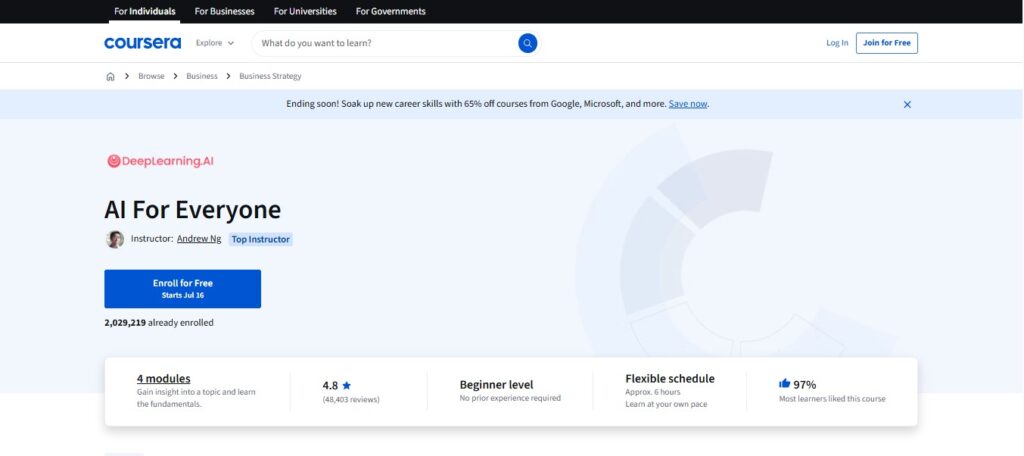
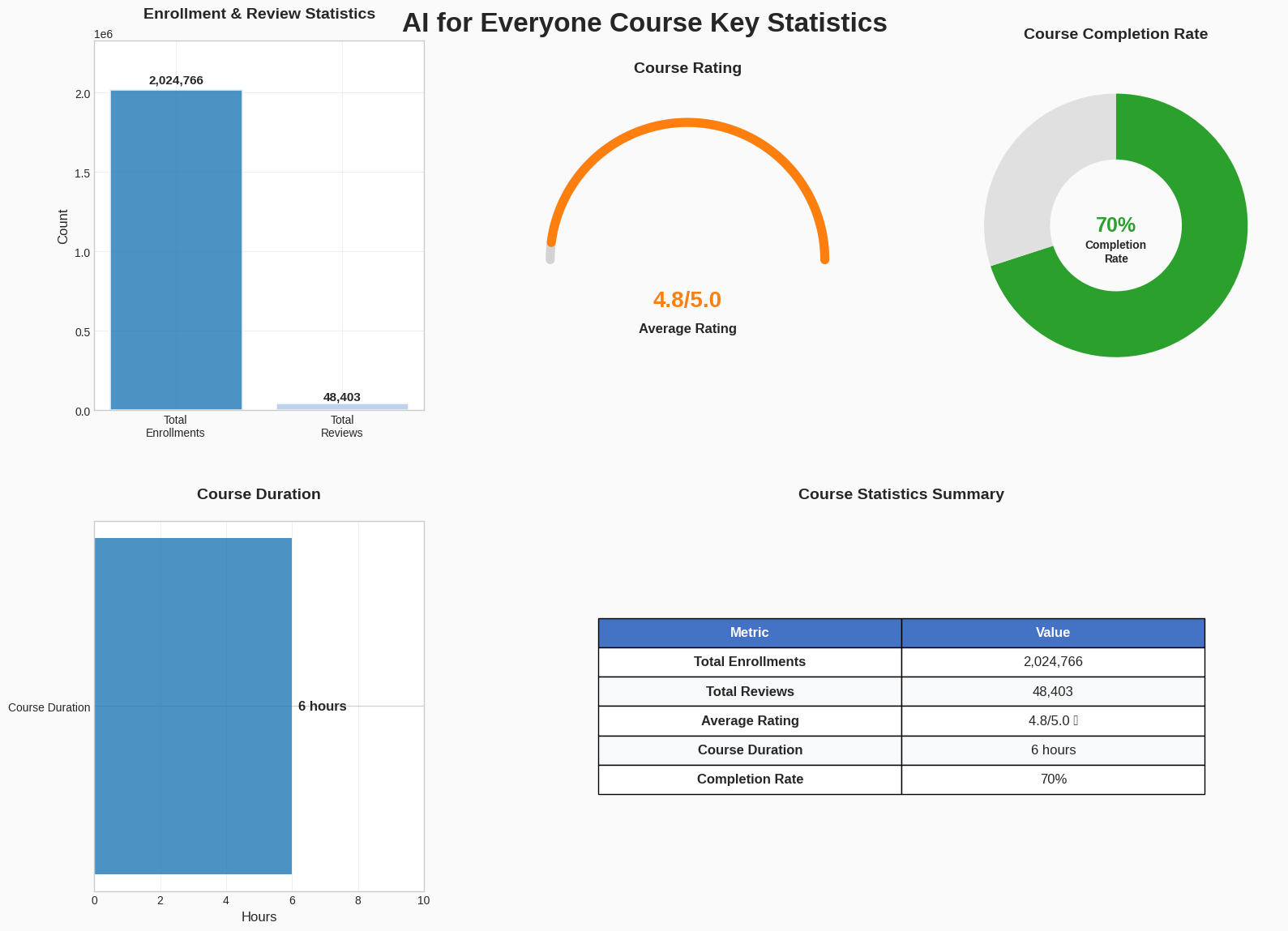
Andrew Ng’s “AI for Everyone” course on Coursera promises to demystify artificial intelligence for non-technical professionals. With over 2 million enrollments and industry acclaim, this course has captured significant attention in the business world.
Course Overview
“AI for Everyone” stands as a comprehensive introduction to artificial intelligence designed specifically for business leaders, managers, and professionals without technical backgrounds. Rather than diving into complex coding or mathematical formulas, the course focuses on practical understanding and strategic implementation of AI technologies.
This four-module program spans approximately 6 hours of content, making it accessible for busy professionals seeking to understand AI’s potential impact on their industries. The course aims to bridge the gap between technical AI development and business strategy, enabling participants to make informed decisions about AI adoption.
The instructor, Andrew Ng, brings unparalleled credentials to this educational endeavor. As a former Stanford University professor, co-founder of Coursera, founding lead of Google Brain, and founder of DeepLearning.AI, Ng possesses both academic rigor and real-world experience. His Ph.D. from UC Berkeley, master’s degree from MIT, and bachelor’s degree from Carnegie Mellon University provide the theoretical foundation, while his work at Google and Baidu demonstrates practical AI implementation at scale.
Furthermore, the course addresses common misconceptions about AI capabilities while providing realistic expectations about what artificial intelligence can and cannot accomplish. This balanced approach helps participants avoid both over-enthusiasm and unnecessary fear regarding AI implementation.
Ng’s teaching methodology emphasizes clarity and accessibility, transforming complex technical concepts into digestible business insights. His experience educating millions of students through various online platforms shines through in the course’s structure and delivery.
Course Rating: 8.5/10
The course earns a solid 8.5 out of 10 rating based on its comprehensive content, expert instruction, and practical applicability. While it excels in accessibility and strategic insights, some participants may find the technical depth insufficient for advanced implementation planning.
This rating reflects the course’s success in achieving its primary objective: making AI accessible to non-technical professionals. The high enrollment numbers and positive student feedback support this assessment, though individual experiences may vary based on prior knowledge and specific learning objectives.
What Will You Learn
The course curriculum covers four essential modules that progressively build your AI knowledge:
Module 1: What is AI?
- Machine learning fundamentals and terminology
- Deep learning concepts and neural networks
- Supervised vs. unsupervised learning distinctions
- Real-world AI applications across industries
- Data science relationship to AI development
- Common AI myths and misconceptions
Module 2: Building AI Projects
- AI project workflow and development cycles
- Data collection and preparation strategies
- Working with AI teams and technical specialists
- Setting realistic expectations for AI project outcomes
- Managing AI project timelines and resources
- Quality assurance and testing methodologies
Module 3: Building AI in Your Company
- AI strategy development for organizations
- Identifying AI opportunities within existing processes
- Managing AI transformation initiatives
- Building AI-ready organizational culture
- Change management for AI adoption
- ROI evaluation and measurement frameworks
Module 4: AI and Society
- Ethical considerations in AI implementation
- Bias detection and mitigation strategies
- AI’s impact on employment and workforce
- Regulatory and governance frameworks
- Privacy and security implications
- Future trends and societal implications
Each module includes practical exercises, case studies, and real-world examples that reinforce learning objectives. The content balances theoretical understanding with actionable insights, ensuring participants can immediately apply their knowledge in professional settings.
“This course provides an excellent introduction, explaining what AI is and what it is actually capable of. The process explanations were very informative.” Coursera Student Review
Detailed Module Breakdown
Week 1: What is AI?
The opening module establishes foundational understanding by defining artificial intelligence, machine learning, and deep learning. Ng carefully distinguishes between these related but distinct concepts, helping participants understand the AI ecosystem’s complexity.
Key topics include supervised learning applications like email spam detection and unsupervised learning examples such as market segmentation. The module also covers data science’s role in AI development, emphasizing the importance of quality data for successful AI implementations.
Participants learn to identify AI opportunities by recognizing patterns in their own industries. The module concludes with realistic assessments of AI capabilities, helping dispel common myths about artificial general intelligence and superintelligence.
Week 2: Building AI Projects
This module transitions from theoretical understanding to practical implementation. Participants explore the machine learning project workflow, from problem identification through deployment and monitoring.
The content emphasizes the iterative nature of AI development, explaining how projects evolve through multiple cycles of data collection, model training, and performance evaluation. Ng provides frameworks for setting realistic project timelines and managing stakeholder expectations.
Special attention is given to data preparation challenges, which often consume 80% of project time. Participants learn to identify data quality issues and understand the importance of representative training datasets.
Week 3: Building AI in Your Company
The third module focuses on organizational transformation, addressing the cultural and structural changes necessary for successful AI adoption. Participants explore AI strategy development, including technology roadmaps and capability building.
Key topics include identifying high-value AI use cases, building internal AI teams, and managing partnerships with external AI providers. The module also covers change management strategies for overcoming resistance to AI adoption.
Ng emphasizes the importance of starting with pilot projects to build organizational confidence and demonstrate AI value. The content includes frameworks for scaling successful pilots across larger organizational units.
Week 4: AI and Society
The final module addresses broader implications of AI adoption, including ethical considerations, bias mitigation, and societal impact. Participants explore regulatory frameworks and governance structures for responsible AI development.
The content covers employment implications, helping participants understand how AI might affect their workforce while identifying opportunities for human-AI collaboration. Privacy and security considerations receive detailed attention, particularly relevant for organizations handling sensitive data.
The module concludes with future trends and emerging technologies, preparing participants for continued AI evolution in their industries.
Source: Coursera Enrollment Data and Student Reviews
Student Testimonials
The course maintains impressive student satisfaction ratings, with participants consistently praising its accessibility and practical value:
Sarah Chen, Marketing Director: “The course helped me understand AI applications in marketing without getting lost in technical jargon. I immediately identified three potential AI projects for our team and felt confident presenting them to senior leadership.”
Michael Rodriguez, Operations Manager: “Andrew Ng’s teaching style made complex concepts digestible. I now feel confident discussing AI initiatives with our technical team and can better evaluate vendor proposals.”
Dr. Jennifer Park, Healthcare Administrator: “The ethics module was particularly valuable for our industry. It provided frameworks for responsible AI implementation in healthcare settings, addressing patient privacy and bias concerns.”
David Kim, Small Business Owner: “As someone with no technical background, I was initially intimidated by AI. This course gave me the confidence to explore AI solutions for my business and understand what’s realistic versus what’s hype.”
Lisa Thompson, Consultant: “The strategic framework provided in Module 3 has been invaluable for my client work. I can now help organizations develop comprehensive AI strategies rather than just implementing isolated solutions.”
Many students appreciate the course’s focus on practical business applications rather than theoretical concepts. The non-technical approach enables participants to engage with AI topics regardless of their technical background.
“Really good course. It provides a good overview of key issues in AI. Useful course for non-technical business leaders wanting to understand key concepts.” Coursera Student Review
Comprehensive Assessment and Assignments
The course includes various assessment methods designed to reinforce learning and provide practical application opportunities:
Quiz Assessments: Each module concludes with comprehensive quizzes testing key concepts and terminology. These assessments help reinforce learning while identifying areas requiring additional attention.
Case Study Analysis: Students analyze real-world AI implementation scenarios, applying course concepts to identify opportunities, challenges, and solutions. These exercises develop critical thinking skills essential for AI strategy development.
Project Planning Exercises: Participants develop AI project proposals for their own organizations, including problem identification, success metrics, and implementation timelines. These exercises bridge theory and practice effectively.
Peer Discussion Forums: Interactive elements encourage students to share experiences and insights from their respective industries. These discussions provide valuable perspectives on AI implementation across diverse sectors.
The assessment structure balances comprehension testing with practical application, ensuring participants can both understand concepts and apply them in professional contexts.
Pros and Cons
Pros:
- Exceptionally accessible for non-technical audiences
- Comprehensive coverage of AI business applications
- Industry-relevant case studies and examples
- Flexible self-paced learning format
- Strong emphasis on practical implementation
- Ethical considerations thoroughly addressed
- Excellent instructor credibility and teaching style
- Interactive elements and peer engagement opportunities
- Downloadable resources and templates
- Global perspective on AI adoption
Cons:
- Limited technical depth for advanced learners
- Brief treatment of emerging AI technologies like generative AI
- Insufficient focus on AI tool selection criteria
Course Structure and Learning Experience
The course follows a logical progression from basic AI concepts to advanced organizational implementation. Each module builds upon previous knowledge while introducing new strategic considerations, creating a comprehensive learning journey.
Video lectures range from 5-15 minutes, making them easy to consume during busy schedules. The bite-sized format allows for flexible learning, accommodating various professional schedules and learning preferences.
The content includes practical exercises, real-world case studies, and interactive elements that reinforce learning objectives. These varied learning methods cater to different learning styles while maintaining engagement throughout the course.
Additionally, the course provides downloadable resources including templates for AI project planning and implementation checklists. These materials prove valuable for immediate application in professional settings, extending learning beyond the course environment.
The platform’s mobile accessibility enables learning on-the-go, while closed captions and transcript availability support diverse learning needs and preferences.
“The course begins with a general definition of machine learning and its relationship to artificial intelligence and deep learning.” Medium Course Review
Target Audience and Prerequisites
The course primarily targets business professionals, executives, and managers who need to understand AI’s strategic implications without requiring technical implementation skills. This includes:
- Business leaders planning AI adoption strategies
- Project managers overseeing AI initiatives
- Consultants advising on AI implementations
- Entrepreneurs exploring AI business opportunities
- Government officials developing AI policies
- Marketing professionals leveraging AI tools
- Healthcare administrators implementing AI solutions
- Financial services professionals exploring AI applications
The course also benefits students and professionals transitioning into AI-related roles who need foundational understanding before pursuing technical training. No prerequisites are required, making it accessible to complete beginners.
The global perspective provided makes the course valuable for international professionals working across different regulatory environments and cultural contexts.
Learning Outcomes and Practical Applications
Upon completion, participants will possess practical knowledge to:
- Evaluate AI opportunities within their organizations using structured frameworks
- Communicate effectively with technical AI teams and vendors
- Develop realistic AI project timelines and expectations
- Identify potential ethical and bias issues in AI implementations
- Create AI adoption strategies tailored to their industries
- Assess AI vendor proposals with informed decision-making criteria
- Manage AI transformation initiatives within their organizations
- Navigate regulatory and compliance considerations
The course emphasizes critical thinking about AI applications rather than blind acceptance of technological solutions. This approach helps participants become discerning consumers of AI services and technologies.
Real-world application examples include participants who have successfully:
- Implemented AI-powered customer service solutions
- Developed AI strategies for digital transformation
- Created AI governance frameworks for their organizations
- Identified and mitigated bias in existing AI systems
- Built cross-functional AI teams within their companies
Course Comparison and Market Position
Compared to other AI courses available online, “AI for Everyone” occupies a unique position in the educational landscape. While technical courses like Ng’s Machine Learning Specialization provide deep implementation knowledge, this course focuses specifically on business strategy and practical application.
The course complements rather than competes with technical AI education, serving as an ideal foundation for leaders who need strategic understanding without coding requirements. This positioning has contributed to its massive enrollment numbers and positive reception.
Unlike vendor-specific AI courses, “AI for Everyone” maintains technology neutrality, helping participants make informed decisions about AI solutions without bias toward particular platforms or providers.
Verdict and Recommendations
“AI for Everyone” succeeds brilliantly in its primary objective of making AI accessible to non-technical professionals. The course provides essential knowledge for anyone needing to understand AI’s business implications without getting bogged down in technical details.
The strategic focus, combined with Andrew Ng’s exceptional teaching ability, creates an invaluable learning experience for business leaders. While technical professionals may find the content too basic, the target audience will discover exactly what they need to navigate the AI revolution confidently.
For organizations planning AI adoption or professionals seeking to understand AI’s impact on their industries, this course represents an excellent investment in foundational knowledge. The combination of practical insights, ethical considerations, and strategic frameworks provides a comprehensive foundation for informed AI decision-making.
The course’s emphasis on responsible AI development and implementation makes it particularly valuable in today’s environment of increasing AI governance and regulatory scrutiny. Participants gain not just technical understanding but also the ethical framework necessary for sustainable AI adoption.
Recommended for: Business leaders, managers, consultants, and professionals who need to understand AI’s strategic implications without technical implementation details. The course serves as an excellent foundation for anyone entering AI-related roles or making AI-related decisions.
Not recommended for: Technical professionals seeking coding skills or deep technical understanding. Those requiring specific AI tool training would benefit more from specialized technical courses.
Video Credit: Daniel | Tech & Data / YouTube
Frequently Asked Questions
Is this course suitable for complete beginners with no technical background?
Absolutely. The course is specifically designed for non-technical professionals and requires no prior knowledge of programming, mathematics, or AI concepts. Andrew Ng carefully explains technical terms in accessible language and focuses on practical applications rather than technical implementation.
The course assumes no technical background and builds knowledge progressively from basic concepts to advanced strategic considerations. Many successful participants come from diverse backgrounds including marketing, healthcare, finance, and general management.
How long does it take to complete the course and what’s the time commitment?
The course requires approximately 6 hours of study time, which can be completed at your own pace. Most students finish within 1-2 weeks by dedicating 30-60 minutes daily to the material.
The flexible format allows you to pause and resume lessons as needed, making it suitable for busy professionals. Each module contains 8-10 video lectures ranging from 5-15 minutes in length, perfect for learning during commutes or lunch breaks. The self-paced structure means you can adjust the timeline to match your schedule.
Will I receive a certificate upon completion and does it have professional value?
Yes, you’ll receive a verified certificate from Coursera and DeepLearning.AI that you can add to your LinkedIn profile, resume, or CV. The certificate demonstrates your understanding of AI fundamentals and business applications, which is increasingly valuable in today’s job market.
However, you’ll need to complete all assignments and quizzes to earn the certificate. The certificate is included with paid enrollment but not available in audit mode. Many professionals report that the certificate has enhanced their credibility in AI-related discussions and opportunities.
Can I apply the knowledge immediately in my workplace and what practical tools are provided?
The course provides practical frameworks and tools that you can implement immediately. You’ll learn to identify AI opportunities, evaluate AI solutions, and develop implementation strategies for your organization. The course includes templates and checklists for AI project planning that you can use right away.
Many students report successfully applying concepts within weeks of completion, including identifying AI opportunities, developing AI strategies, and improving communication with technical teams. The practical focus ensures immediate applicability rather than just theoretical knowledge.
How does this course compare to other AI courses available and what makes it unique?
This course stands out for its business focus and non-technical approach. While other courses may provide deeper technical knowledge, “AI for Everyone” excels in practical business applications and strategic thinking. It’s ideal for professionals who need to understand AI’s impact without becoming technical practitioners.
The course complements rather than competes with technical AI courses, serving as an excellent foundation before pursuing more advanced training. Andrew Ng’s reputation and teaching ability, combined with the course’s strategic focus, create a unique learning experience that balances accessibility with depth.
Sources:
- AI For Everyone – Coursera
- DeepLearning.AI Course Information
- Andrew Ng Professional Background
- Class Central Course Review
- Medium Course Analysis
- Learn Data Science AI Course Rankings
- Coursera Blog Leadership Information
- Stanford HAI Andrew Ng Profile
Read More: