

The Udemy Machine Learning A-Z : AI, Python & R + ChatGPT Prize course has become one of the most popular course for beginners and intermediate learners seeking hands-on training in machine learning.
This article will examines the course’s structure, content quality, teaching style, and practical value to help you decide if it’s the right fit for your learning goals.
Thousands of students have completed this course and pursued careers in data science, AI, and software engineering. Our analysis covers everything from curriculum depth to instructor expertise, so you can make an informed choice before enrolling.
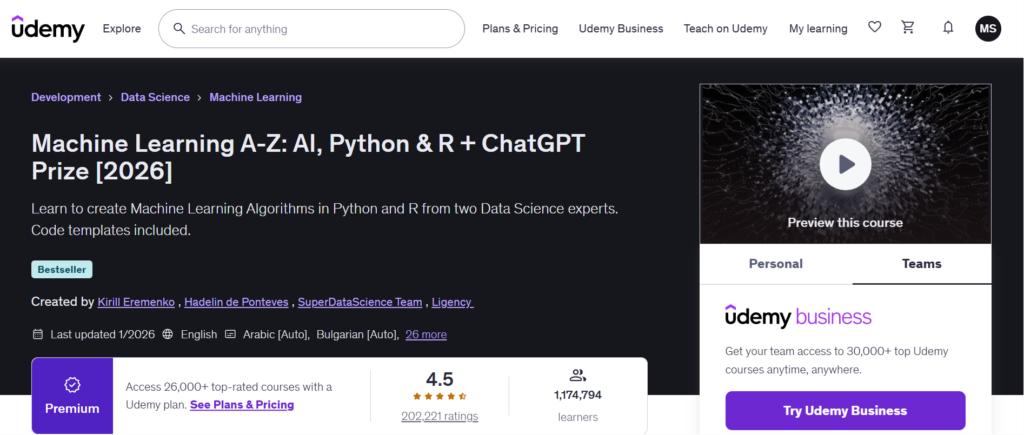
Course Overview
The Udemy Machine Learning A-Z : AI, Python & R + ChatGPT Prize course spans 42h 44m hours of video content divided into digestible sections. The course covers supervised learning, unsupervised learning, reinforcement learning, and advanced techniques. You’ll work with Python, R, and various machine learning libraries throughout the program.
The structure follows a logical progression from fundamentals to complex algorithms.
“This is one of the best Machine Learning online courses. It’s comprehensive (44 hours of content) yet engaging, it’s hands-on yet detailed, and the instructors Kirill Eremenko and Hadelin de Ponteves break down complex concepts into digestible lessons.” Source: Medium – JavaRevisited
Early modules introduce you to core concepts like data preprocessing and feature scaling. On the middle sections, it dive deeper into classification, regression, and clustering algorithms. Final modules explore advanced topics such as reinforcement learning and natural language processing basics.
Each section includes video lectures, downloadable resources, and coding exercises. The course provides datasets that you can use to practice real-world scenarios. Quizzes appear throughout the course to test your understanding before moving forward.
Video Credit: Daniel | Tech & Data / YouTube
Who This Course For
This course works best if you have basic programming knowledge, preferably in Python or R. Beginners completely new to coding might struggle with pacing and concepts. If you’ve already completed an intro to programming course, you’re in a good starting position.
The course suits career changers who want to enter data science or machine learning roles. It also benefits current professionals looking to add machine learning skills to their expertise. Students aiming for data science interviews will find practical algorithms and implementation experience here.
You don’t need advanced mathematics to follow along. The course teaches mathematical concepts where needed without heavy theory. But, understanding basic statistics and algebra helps you grasp why algorithms work the way they do.
If you’re already experienced in machine learning and seeking advanced topics, this course may feel too introductory. It’s designed for those starting their machine learning journey, not for PhD-level practitioners.
Content Quality Curriculum
The curriculum covers all major machine learning algorithms you need to know. Here’s what the course includes:
- Supervised learning: Linear regression, logistic regression, decision trees, random forests, SVM
- Unsupervised learning: K-means clustering, hierarchical clustering, DBSCAN
- Advanced techniques: Dimensionality reduction, model evaluation, hyperparameter tuning
- Practical applications: Recommendation systems, natural language processing, time series analysis
The instructors use real datasets from Kaggle and other sources. You’ll work with data ranging from house prices to customer behavior patterns. This variety keeps lessons practical and relevant to actual data science work.
| Algorithm Type | Number of Lessons | Estimated Hours |
|---|---|---|
| Regression | 8 | 4 |
| Classification | 10 | 5 |
| Clustering | 6 | 3 |
| Advanced Topics | 7 | 4+ |
Each algorithm section follows the same pattern: theory explanation, Python/R implementation, and hands-on practice.
Code templates are provided so you can focus on understanding rather than debugging syntax errors. The balance between theory and practice is well-executed.
Hands-On Projects Practical
The course includes multiple capstone projects that combine several algorithms. You’ll build a customer segmentation project using clustering techniques. Another project has you predict house prices using regression models. These projects mirror real-world data science tasks.
You get complete code repositories and datasets for each project. This means you can follow along step-by-step or attempt the project independently first. Solutions are provided, so you can compare your approach with the instructors’ methods.
Building Your Portfolio
Completing these projects gives you portfolio pieces to show potential employers. You can download the code, modify it, and push it to GitHub. Employers value practical experience demonstrated through actual projects more than certificates alone.
The projects aren’t overly simplified. You’ll encounter real data quality issues like missing values and outliers. You’ll need to make decisions about feature engineering and model selection. This prepares you for actual data science work where problem-solving matters more than memorization.
Real-World Application
Each project teaches you how to approach a new machine learning problem. You’ll learn to frame business questions as machine learning problems. You’ll discover how to evaluate whether your model actually solves the stated problem. These meta-skills transfer directly to any machine learning role you pursue.
The projects use accessible datasets that don’t require massive computing power. You can complete everything on a laptop with standard specifications. Cloud resources aren’t necessary, making the course more accessible to students on tight budgets.
Instructor Quality Teaching
The course is taught by Kirill Eremenko and Hadelin de Ponteves, both experienced data scientists. Kirill has worked in data science for over a decade and previously taught machine learning at university level. Hadelin brings expertise in neural networks and deep learning. Their combined experience shows in how they explain complex concepts clearly.
The teaching style emphasizes understanding over memorization. Instructors explain why algorithms work, not just how to use them. They share common mistakes students make and how to avoid them. This guidance prevents you from developing bad habits early in your learning journey.
The pacing is deliberate and thorough. Instructors don’t rush through important concepts. They pause frequently to let information settle. Videos include visual animations that show how algorithms operate, making abstract concepts concrete and understandable.
Instructor engagement extends beyond video lectures. They respond to student questions in the course Q&A section.
Updates arrive periodically to keep content current with library changes and new best practices. This ongoing support distinguishes this course from abandoned or outdated offerings.
Pricing Value Money
The Udemy Machine Learning A-Z : AI, Python & R + ChatGPT Prize course typically costs between $10 and $100 depending on Udemy’s current promotions. Udemy frequently offers discounts, with prices often dropping to $12–$15 during sales. The regular price is $159.99, but rarely do students pay full price.
Compare this to bootcamps charging $10,000–$20,000 for similar material. Online alternatives like Coursera or edX often require paid certificates, adding to costs. Self-teaching through books and free resources requires more time and discipline. This course delivers structured, comprehensive content at a fraction of other options’ cost.
The investment pays for itself quickly. A single machine learning freelance project or a salary increase in a data science role recovers the course cost instantly. Students report using skills from this course to land jobs paying $60,000–$120,000 annually. The return on investment is substantial.
Udemy frequently offers lifetime access to course materials. You’re not paying for temporary access. You can revisit lessons, download resources, and access updates years after enrollment. This makes the per-hour cost extremely low over time.
Pros Cons
Pros:
- Comprehensive coverage of all major machine learning algorithms
- Clear instruction from experienced data scientists
- Practical projects with real-world datasets
- Affordable pricing with frequent discounts
- Lifetime access to course materials and updates
- Python and R implementations provided for each algorithm
- Downloadable resources and code templates
- Active instructor support in Q&A section
Cons:
- Some advanced topics feel rushed near the end
- Mathematical theory isn’t explained in deep detail
- No live mentorship or direct feedback on your projects
- Large dataset projects may run slow on older computers
- Some outdated library versions in occasional code examples
- Limited discussion of deployment and production concerns
- No job guarantee after completion
The pros substantially outweigh the cons for most learners. The course delivers what it promises: practical machine learning education at an accessible price. The cons reflect limitations inherent to online courses rather than poor execution.
Is This Worth Taking
Yes, this course is worth taking if you’re beginning your machine learning journey. The instructors teach clear fundamentals that stick with you. The practical projects build skills you’ll use immediately in data science work.
This course becomes your foundation for advanced learning. After completing it, you’ll understand which algorithms suit different problems. You’ll know how to carry out solutions in Python or R. You’ll have portfolio pieces demonstrating practical capability.
“The course helped me understand key concepts clearly and improved my analytical thinking. The combination of theory and practical examples made complex algorithms accessible. I particularly appreciated the real-world datasets and the step-by-step coding approach.” Source: Udemy Course Reviews
The decision becomes clearer when you consider your goals. Are you aiming for a data science career? This course efficiently builds that foundation. Do you want to add machine learning skills to existing expertise? This course teaches you quickly without wasting time on irrelevant material.
Invest time in completing the projects rather than just watching videos. The true value emerges when you apply concepts to problems. Students who finish projects report greater confidence and better job prospects than those who only watch lectures.
The course won’t make you a machine learning expert alone. Expertise requires applying these skills to varied problems over months or years. But, this course accelerates your path by teaching you what matters most and what to practice next.
Frequently Asked Questions
What is the Udemy Machine Learning A-Z : AI, Python & R + ChatGPT Prize course and who teaches it?
The Udemy Machine Learning A-Z : AI, Python & R + ChatGPT Prize is a 42h 44m hours comprehensive course taught by Kirill Eremenko and Hadelin de Ponteves, experienced data scientists. It covers supervised, unsupervised, and reinforcement learning with Python and R implementations for practical skill-building.
How much does the Udemy Machine Learning A-Z : AI, Python & R + ChatGPT Prize course cost?
The regular price is $159.99, but Udemy frequently offers promotions dropping the cost to $12–$15. Sales are common, making the actual price typically between $10–$30. Lifetime access ensures you can revisit materials indefinitely after enrollment.
What prerequisites do I need to take the Udemy Machine Learning A-Z : AI, Python & R + ChatGPT Prizecourse?
Basic programming knowledge in Python or R is essential. You don’t need advanced mathematics, but understanding basic statistics and algebra helps. Beginners completely new to coding may struggle with pacing and concept complexity.
Does the Udemy Machine Learning A-Z : AI, Python & R + ChatGPT Prizecourse include real-world projects?
Yes, the course features multiple capstone projects including customer segmentation using clustering and house price prediction with regression models. You receive complete code repositories and datasets, creating portfolio-ready pieces you can showcase to employers on GitHub.
Is machine learning certification worth pursuing for career advancement?
Certifications alone matter less than practical experience. Employers value portfolio projects and demonstrated skills more than certificates. Completing hands-on machine learning projects gives you credible proof of capability that significantly improves job prospects and earning potential.
What are the main limitations of taking the Udemy Machine Learning A-Z : AI, Python & R + ChatGPT Prize course?
The course lacks live mentorship and direct project feedback. Advanced topics feel rushed toward the end, and mathematical theory isn’t covered deeply. There’s limited discussion of deployment and production concerns, and no job guarantee after completion.
Sources:
- Udemy Official Course Page
- FreeCodeCamp – Machine Learning Course Rankings
- Medium – Java Revisited Course Review
- Reddit – r/learnmachinelearning Discussion
- BD Tech Talks – Community Review
Read More: