

Last updated on December 26th, 2025 at 12:09 pm
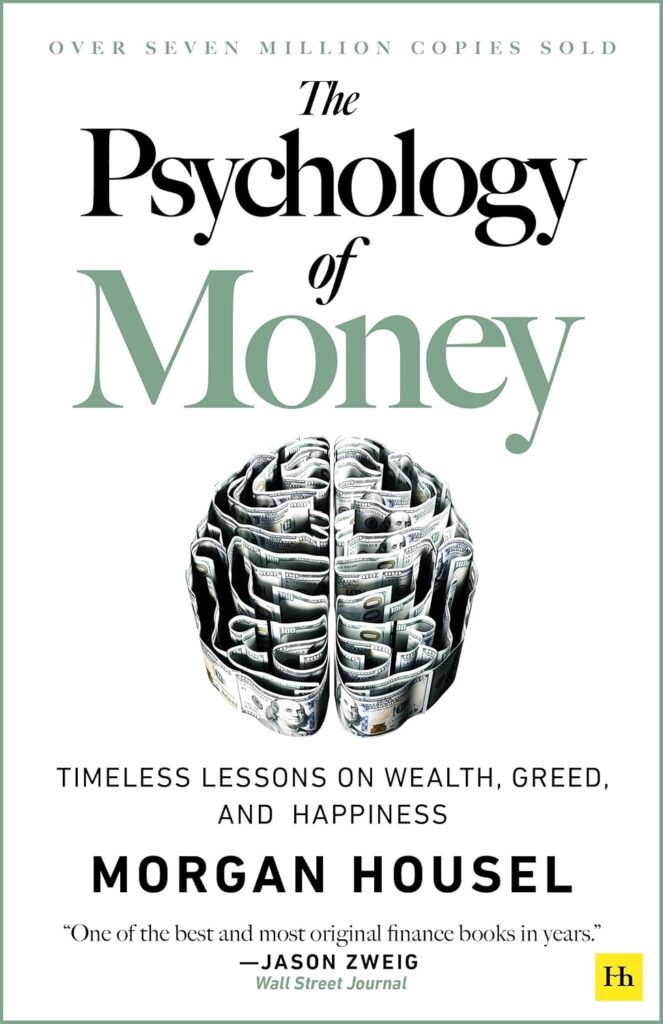
Your relationship with money shapes every major life decision, yet most people understand it less than they think. Morgan Housel’s “The Psychology of Money” revolutionizes how we think about wealth, success, and financial behavior through powerful storytelling and behavioral insights.
Is "The Psychology of Money" worth reading for better financial decisions? Absolutely. This bestselling book reveals how behavior trumps intelligence in building wealth, offering timeless lessons on money psychology that apply regardless of your income level or investment knowledge.
The Money Mindset Revolution
Society has consistently misunderstood what drives financial success for generations. Meanwhile, Morgan Housel’s “The Psychology of Money” arrives as a much-needed paradigm shift from traditional financial advice. The book systematically dismantles the myth that mathematical intelligence determines financial outcomes.
Furthermore, Housel traces how our culture developed harmful money beliefs through generational experiences. Different generations witnessed vastly different economic realities—from the Great Depression to the dot-com boom—creating conflicting financial philosophies within families and workplaces.
The current statistics paint a concerning picture. According to the Federal Reserve’s 2024 Survey of Consumer Finances, 63% of Americans couldn’t cover a $500 emergency expense. This isn’t just about income levels—it’s about fundamental misunderstandings of how money actually works in our daily lives.
“Doing well with money isn’t necessarily about what you know. It’s about how you behave.” Morgan Housel
Behavioral Finance Foundation
The book’s strength lies in its psychological approach to understanding financial decision-making. Housel weaves together decades of behavioral research, historical examples, and real-world case studies to paint a comprehensive picture of why smart people make poor money decisions. He explores how emotions, cognitive biases, and social pressures influence our financial choices.
Additionally, the research reveals fascinating insights about wealth accumulation patterns. Studies from Harvard Business School show that consistent behavior matters more than investment returns for long-term wealth building. This challenges the conventional wisdom that financial success requires superior market knowledge.
The author also examines how personal experiences shape money beliefs more than formal education. Historical examples include how people who lived through hyperinflation develop different spending habits than those who experienced steady economic growth. Housel explains the psychological mechanisms that make past experiences such powerful financial decision drivers.
Housel’s background as a partner at Collaborative Fund and former columnist at The Wall Street Journal lends credibility to his behavioral insights. He distinguishes between logical financial advice and psychologically sustainable practices, providing readers with realistic approaches to wealth building.
The 19 Money Lessons
Moving beyond traditional financial education, Housel provides nineteen profound insights that reshape how we think about money. He breaks down complex behavioral patterns into digestible stories and actionable wisdom. This knowledge helps readers understand why they make certain financial choices and how to improve them.
The book reveals how different people define wealth and success based on their unique circumstances. Some prioritize financial security, others seek status symbols, and many struggle to balance both desires. Understanding these motivations helps readers make more intentional financial decisions aligned with their personal values.
Housel also addresses how money psychology changes throughout your lifespan. Young adults naturally take more risks, while older individuals prioritize preservation. These shifts aren’t just practical—they’re psychological necessities that reflect changing priorities and life circumstances.
“The line between ‘inspirationally bold’ and ‘foolishly reckless’ can be thin and only visible in hindsight.” Morgan Housel
Wealth vs. Rich Distinction
The book presents compelling evidence about the difference between being wealthy and being rich. Housel explains how wealth represents assets that provide options and security, while being rich means having a high income. These concepts are frequently confused but represent fundamentally different financial states.
Wealth-building requires different psychological skills than income generation. The book details how controlling expenses and living below your means creates wealth more reliably than pursuing higher incomes. This connection between psychology and wealth accumulation has become particularly relevant in our consumer-driven economy.
The invisible nature of wealth creation poses unique challenges. Unlike high incomes, true wealth doesn’t display itself through consumption. Research from Thomas Stanley’s studies confirms that most millionaires live modestly while building assets systematically.
Perhaps most importantly, Housel explains how wealth provides something money can’t buy: options. Wealthy individuals can make career changes, take risks, and weather financial storms because they’ve built financial cushions that provide flexibility and peace of mind.
The Power of Compounding
One of the book’s most compelling sections explores compound interest’s psychological dimensions. Housel explains how your brain struggles to comprehend exponential growth, making it difficult to appreciate compounding’s long-term power. Without understanding this psychological barrier, most people underestimate time’s importance in wealth building.
The process involves both mathematical and behavioral components. While everyone knows the mathematical formula for compound interest, few people develop the patience and discipline required to harness its power. The book explains how to overcome psychological obstacles that prevent long-term thinking.
Research from Vanguard’s 2024 investor behavior study confirms that time in the market beats timing the market for most investors. Students and professionals who understand this principle make fundamentally different financial decisions than those who don’t.
The book also reveals how compounding applies beyond investments. Skills, relationships, and reputation all compound over time when consistently developed. This broader view of compounding helps readers appreciate delayed gratification in multiple life areas.
Luck and Risk Analysis
Housel addresses the uncomfortable truth about luck’s role in financial outcomes. He critiques the tendency to attribute success entirely to skill while dismissing the role of circumstance, timing, and random events. The book presents evidence that acknowledging luck’s influence actually improves financial decision-making.
The author examines how confirmation bias affects financial planning. People often create narratives that explain their financial outcomes while ignoring contradictory evidence. This psychological tendency leads to overconfidence and poor risk assessment in future financial decisions.
Risk management receives particular attention throughout the book. Housel explains how people systematically underestimate tail risks—low-probability events with severe consequences. These blind spots have profound implications for retirement planning, insurance decisions, and investment strategies.
“Risk is what’s left over when you think you’ve thought of everything.” Morgan Housel
Practical Money Strategies
The book provides twelve evidence-based approaches for improving financial behavior:
- Define “enough” to avoid lifestyle inflation and endless comparison
- Save for flexibility rather than specific goals or purchases
- Expect and plan for volatility in markets and personal circumstances
- Use money to buy independence and options rather than status symbols
- Maintain room for error in all financial planning and decision-making
- Avoid extreme financial positions that could jeopardize long-term goals
- Focus on time horizons appropriate for your personal situation
- Embrace reasonable over rational in investment and spending decisions
- Build wealth invisibly through consistent saving and investing
- Understand your personal money psychology and plan accordingly
- Separate ego from financial decisions to avoid costly mistakes
- Create sustainable financial habits that work with your psychology
Score: 9/10
This book deserves an exceptional rating for its unique approach to financial education and life-changing insights. Housel successfully transforms abstract behavioral concepts into practical wisdom while providing evidence-based strategies for better financial decision-making.
The only minor drawback is that some readers seeking specific investment advice might find the philosophical approach less actionable than traditional finance books. However, this psychological foundation proves essential for implementing any financial strategy successfully.

What Will You Learn
After reading “The Psychology of Money,” you’ll understand:
- Why intelligent people make poor financial decisions and how to avoid common pitfalls
- The psychological differences between wealth building and income generation
- How personal experiences shape money beliefs more than formal education
- Why compound interest works psychologically as well as mathematically
- How to define “enough” in a consumer-driven society that promotes endless wants
- The role of luck and risk in financial outcomes and planning
- Why reasonable beats rational in most financial decision-making scenarios
- How to build wealth through behavior rather than superior market knowledge
Reader Testimonials
“This book completely changed how I think about money. I used to stress about finding the perfect investment, but now I focus on consistent behavior and patience. My relationship with money is so much healthier.” – Sarah M., Teacher
“I’ve read dozens of finance books, but this one actually stuck. The stories made complex concepts click for me. I finally understand why I made certain financial mistakes and how to avoid them.” – David K., Engineer
“The chapter on ‘enough’ was life-changing. I was always chasing more money without understanding what I actually needed. Now I have clear financial goals and genuine peace of mind.” – Lisa R., Business Owner
Pros and Cons
Pros:
- Accessible writing style that makes complex behavioral concepts understandable
- Real-world stories that illustrate abstract financial principles effectively
- Focus on sustainable behavior over technical analysis or market timing
- Timeless wisdom that applies regardless of market conditions or income levels
- Practical insights for readers at any financial stage or experience level
Cons:
- Limited specific investment advice or detailed financial planning strategies
- Some readers might prefer more actionable tips over philosophical insights
- Occasional repetition of key concepts throughout different chapters
Historical Context and Examples
The book examines fascinating historical examples that illuminate money psychology. Housel analyzes how different generations developed distinct financial behaviors based on their formative economic experiences. These historical patterns help readers understand their own money psychology and make more intentional financial decisions.
Research from the Federal Reserve Bank of St. Louis shows that people who experienced high inflation in their youth tend to invest more conservatively throughout their lives. This demonstrates how early experiences create lasting financial behavioral patterns.
The book also explores how social and cultural factors influence money decisions. Different societies have varying approaches to debt, saving, and consumption based on their historical experiences and cultural values. Understanding these influences helps readers make more conscious financial choices.
Investment Psychology Insights
Housel addresses investment behavior with remarkable clarity. He explains how emotional factors like fear and greed drive most investment mistakes, while logical analysis often gets overwhelmed by psychological biases. The book provides frameworks for making better investment decisions by understanding these psychological patterns.
The author also examines how different time horizons affect investment psychology. Short-term thinking leads to reactive decision-making, while long-term perspectives enable more rational choices. This research has implications for retirement planning and wealth accumulation strategies.
Market volatility receives particular attention throughout the book. Housel explains how people systematically underestimate their tolerance for market fluctuations, leading to poor timing decisions. By understanding these psychological tendencies, readers can develop more appropriate investment strategies.
Verdict
“The Psychology of Money” stands as essential reading for anyone serious about building long-term wealth and financial security. Housel’s unique approach transforms money from a technical subject into a psychological journey, providing insights that apply regardless of your income level or investment experience.
The book succeeds in making behavioral finance accessible while maintaining scientific rigor. Whether you’re a recent graduate starting your career or a seasoned professional planning for retirement, this book provides the psychological foundation needed for better financial decision-making.
Most importantly, Housel’s work helps you understand that financial success isn’t about being the smartest person in the room—it’s about developing sustainable behaviors that work with your psychology rather than against it. In a culture that often promotes get-rich-quick schemes and complex investment strategies, this book presents a refreshingly honest approach to building wealth.
The book’s impact extends beyond individual financial improvement. It challenges educational systems, workplace cultures, and societal assumptions about money and success. By reading “The Psychology of Money,” you’re not just gaining personal insights—you’re developing a more mature and sustainable approach to financial decision-making that will serve you throughout your life.
Video Credit: The Swedish Investor / YouTube
Is the book suitable for beginners with no financial background?
Absolutely. Housel excels at explaining complex behavioral concepts through relatable stories and examples. You don’t need any prior knowledge of finance or investing to understand and benefit from this book. The author uses analogies, historical examples, and clear explanations that make even the most intricate psychological concepts accessible.
The book balances behavioral insights with practical wisdom, making it suitable for complete beginners while providing valuable perspectives for experienced investors. Housel’s gift for storytelling helps readers grasp complex concepts without oversimplifying the underlying psychology.
How long does it take to change financial behavior after reading this book?
Many readers report shifts in their money mindset within the first few weeks of reading. However, more significant behavioral changes typically occur over 2-6 months as new habits replace old patterns. The book provides both immediate insights and long-term strategies for sustainable financial behavior change.
The key is implementing one or two concepts at a time rather than attempting to change everything simultaneously. Housel’s emphasis on sustainable behavior makes gradual implementation more effective than dramatic lifestyle changes.
Does the book provide specific investment recommendations?
While the book covers investment psychology extensively, it doesn’t provide specific stock picks or detailed investment strategies. Housel focuses on behavioral principles that apply to any investment approach rather than advocating for particular assets or strategies.
For specific investment advice, the book encourages developing a personal investment philosophy based on your psychology and circumstances. The behavioral insights provide the foundation for making better investment decisions regardless of your chosen strategy.
Are the lessons applicable outside the United States?
The psychological principles in the book apply universally, though some examples are US-centric. Money psychology operates similarly across cultures, making the core insights valuable for readers worldwide. Different countries may have varying financial systems, but the underlying behavioral patterns remain consistent.
International readers will find the behavioral insights particularly valuable, as they can adapt the principles to their local financial systems and cultural contexts. The book’s focus on psychology rather than specific financial products makes it globally relevant.
Can this book help with debt management and budgeting?
While the book doesn’t provide detailed budgeting spreadsheets or debt repayment strategies, it offers psychological insights that make budgeting and debt management more sustainable. Understanding your money psychology helps you develop realistic financial plans that work with your behavioral tendencies rather than against them.
The book’s emphasis on defining “enough” and building wealth invisibly provides a strong foundation for debt management and spending control. Readers often find that changing their money mindset naturally leads to better budgeting and debt management practices.
Purchase: Get The Psychology of Money on Amazon
Sources:
- Federal Reserve Survey of Consumer Finances 2024
- Harvard Business School Research on Wealth Building
- Federal Reserve Bank of St. Louis Demographics and Financial Behavior
- Vanguard Investor Behavior Study 2024
- The Millionaire Next Door Research
Read More: